
Ground Rules: Public Art and Civic Spaces
Panel Discussion
May 8, 2026
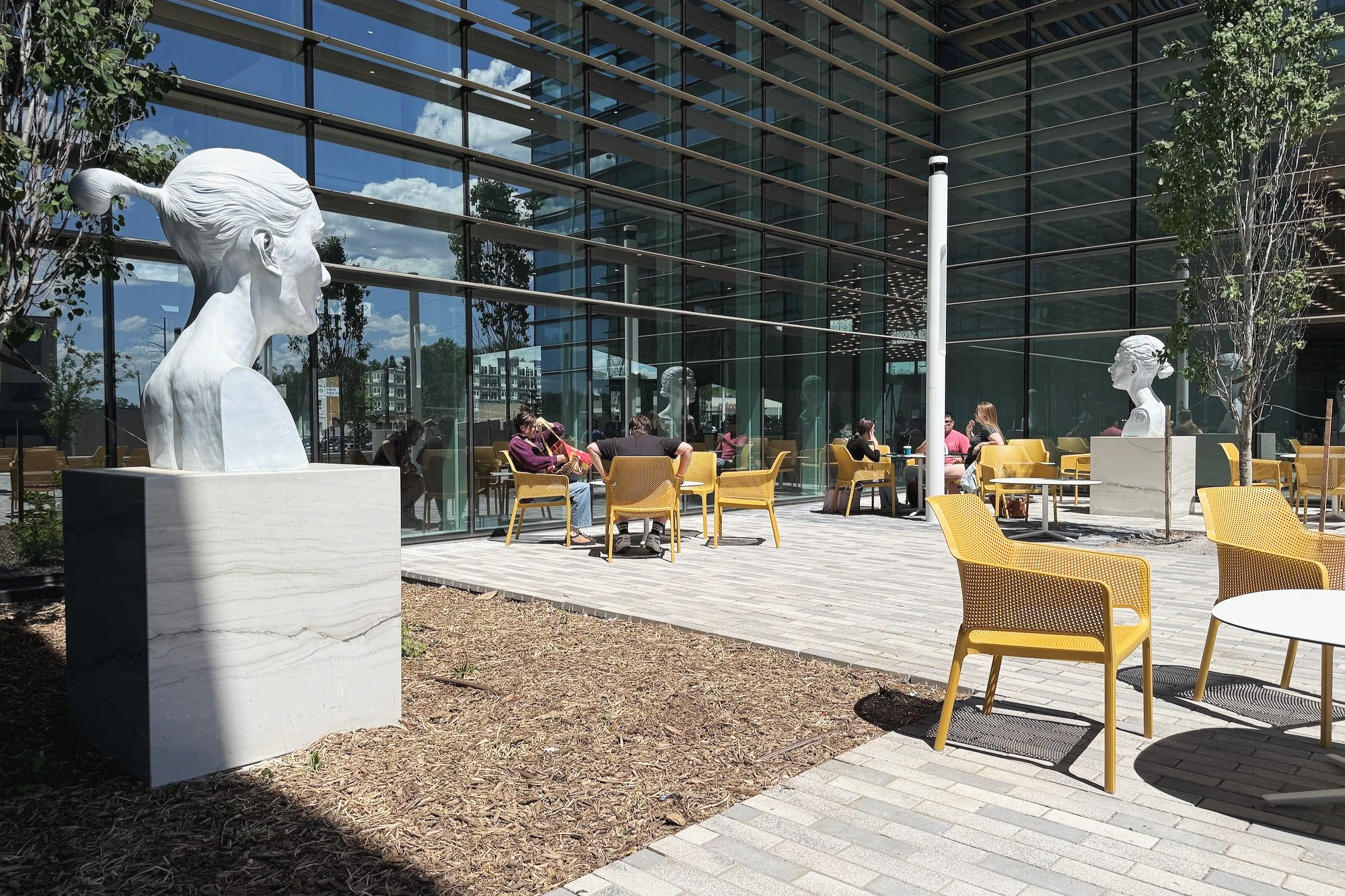
On May 8th, artists Celeste Butler and Littleton Alston sat down with Omaha Public Library Partnerships Manager Amy Mather and Amplify’s Lauren Martin to discuss how public artwork actively reshapes civic spaces, particularly libraries, by interrupting patterns, inviting reflection, and redistributing attention to make room for more voices, more histories, and more ways of belonging.
Transcript
Title of Discussion: Ground Rules: Public Art and Civic Spaces
Panelist 1: Littleton Alston
Panelist 2: Celeste Butler
Panelist 3: Amy Mather
Moderator: Lauren Martin
Date of Discussion: May 8th, 2026
List of Acronyms: [LA] = Littleton Alston; [CB] = Celeste Butler; [AM] = Amy Mather; [LM] = Lauren Martin
[LM] Welcome to the Central Library. This is Amplify Arts’ Quarterly Discussion Series, Ground Rules, where we explore how public art makes and shapes the civic environment here in this place we live. If you're not familiar, Amplify Arts is a nonprofit. We support place-based creative work that investigates our present while opening pathways toward new futures and more inclusive and engaging public spaces.
My name is Lauren Martin, and we're especially proud and grateful to be having this discussion at Omaha Central Library today. For more than two years, we've been really lucky to help integrate artists and their work into this incredible space. It's an honor to be here with a couple of the artists, library partners, and you all. If you haven't already, we certainly invite you to explore and take advantage of all of the incredible resources the Omaha Central Library and the Omaha Public Library branches have to offer.
We’re grateful to have Littleton Alston, Amy Mather, and Celeste Butler sharing their time with us today. Sculptor Littleton Alston lives and works in Omaha, Nebraska, where he's also a professor of sculpture at Creighton University. His works have been exhibited nationally and internationally and are included in many public and private collections, including the Omaha Central Library. Littleton has been featured on the PBS NewsHour and in documentary films produced by Nebraska Public Media and the National Willa Cather Center. He has been an artist-in-residence at the Bemis Center for Contemporary Arts, at the Martine Vaugel Studio in France, and at the International Center for the Arts in Italy. Littleton earned his MFA degree from the Reinhardt School of Sculpture at the Maryland Institute College of Art and his BFA from Virginia Commonwealth University.
Celeste Butler is a fiber artist and storyteller whose work brings together history, culture, and community through the art of textiles. Known for her intricate use of fabric, beads, and repurposed materials, she creates pieces that celebrate heritage and resilience. Her practice centers on preserving African and African-American narratives through the tactile language of quilting and collage. Deeply rooted in Omaha, Celeste's work connects generations by honoring the past while inspiring new stories of identity and belonging.
Amy, would you introduce yourself?
[AM] Hi everyone. I’m Amy Mather, and I’m the Partnerships Manager at Omaha Public Library. That really just means that my job here is still about storytelling, relationships, and connecting people. That is my heart and soul. I work with a lot of nonprofits, like Amplify, and that’s one of the reasons I love being here in Omaha. There are so many great organizations here and people who really care about making this city better. I’m not a Nebraska native. I grew up in West Virginia, lived in New Mexico, Louisiana, and I moved here from Washington, D.C. I’m so grateful to be able to welcome you all to this beautiful new space on behalf of Omaha Public Library.
[LM] Thank you, Amy, and thank you all for being here today.
For a little context to start, libraries are uniquely democratic environments. They are free, open to all, and structured around principles of access, knowledge-sharing, and civic participation. When art is integrated into library spaces, it reinforces those principles and expands them into the realms of experience, identity, and belonging.
A spatial reading of libraries begins with their geometries. Axes organize movement, thresholds signal entry and transition, nodes gather people, and transitional zones invite pause. Public art engages these geometries not as passive backdrops but as active conditions. Installed along circulation paths, art can interrupt or slow movement, encouraging reflection; positioned within central nodes, it can anchor shared attention and collective experience; embedded in thresholds, it can mark moments of crossing into knowledge, into community, into civic life. In this way, art enhances the libraries as relational spaces where spatial experience shapes social interaction.
Doreen Massey’s concept of “power geometry” deepens this understanding by foregrounding how users experience and move through space differently. Massey argues that space is constituted through relations of power, where mobility, access, and the ability to shape spatial narratives are unevenly distributed. Applied to library environments, this suggests that even spaces designed to be open and democratic are experienced differently depending on one’s social position, cultural background, or familiarity with institutional norms.
Public art, when thoughtfully integrated, can intervene in these dynamics. By engaging the geometries of the library, artists can redistribute attention and visibility to center marginalized histories, languages, and perspectives that might otherwise remain peripheral. For example, works placed in highly trafficked nodes can elevate narratives that challenge dominant cultural assumptions. At the same time, interventions in quieter or transitional spaces can create zones of intimacy and recognition for communities who may not always feel centered in civic institutions. In Massey’s terms, art can reconfigure the “power geometry” of the space by altering who is seen, who is addressed, and who feels entitled to occupy and interpret the environment.
This reconfiguration is central to cultivating a sense of belonging. When individuals encounter artwork that reflects their experiences or invites their participation, the library's spatial logic shifts from passive use to active co-presence. The openness of the library, its lack of economic barriers, and its permeability across social groups mean that these encounters occur across differences, allowing multiple publics to see themselves as part of a shared, plural civic history.
As people move through the library’s geometries and encounter artworks that resonate, challenge, or affirm, they begin to form affective attachments not only to the space but to the idea of the public itself. The library becomes a site where the distribution of visibility and voice feels more equitable, where cultural expression is recognized as a shared resource. In this sense, public art functions as a form of civic infrastructure that both reflects and reshapes the power relations embedded in space.
Ultimately, the significance of art in library spaces lies in its ability to align spatial form with social meaning while actively negotiating the inequalities that structure public life.
With that, would each of you share more about your practice? How do questions of space, audience, and public engagement show up in your work? Littleton, do you want to start?
[LA] I think it's an interesting question. I think that for a sculptor, we constantly think about space and spatial relationships. And sometimes we're drawn to how people move through those spaces. I remember at VCU, when we had our first design classes, our professor would say, you know, if we were elephants, our chairs would be different. Our doorways would be different. Everything that we have is designed to accommodate our physical form, in some capacity or another, whether it's a spoon, knife, or fork. And how do we utilize those things in relation to our bodies? How do we give access to all that? And I don't just mean physical access, but I'm also talking about conceptual access and being able to communicate with the work.
So for me, I like to think I'm inspired by certain things, and those things become the driving force in my research. I follow my heart, I follow my past work, but I also explore new places I want to go. I have a deep tie to spiritual things, which I don't speak of enough. Those motivators guide me. I find that as I get older, I become more efficient in my thinking. I also become more curious about questions I've been wanting to answer for some time. And so many of those questions might be about the human condition. They might be about how light falls on form or negative space throughout form. These are sculptural questions, but they can also be general artistic questions. If I'm doing a commission, and I've done about 30 commissions in my lifetime, some very grand and some rather modest, then I find that to be more of a collaborative conversation with other stakeholders and communities.
[CB] I want to say thank you to each one of you who took the time to show up in space physically. We all have choices and options for other places to be, and I'm honored when you physically show up for conversations like this. Because it's not just the physical artwork that connects people, it's all the conversations that happen in addition to that.
My work generally comes from conversations or experiences that I've had and that I want to continue. The piece I made for the library is titled Access Granted, and I called it that for a reason. For me, having access to the library at a time in my life when a lot of things were not accessible was so important. I was creating for the little girl in me who needed space, who needed a safe place, who needed a place to meet with her friends. That's why you'll see three children in my piece. Telling stories about the things that reinforce our shared humanity is so important to me and to my work. So when we're talking about civic spaces, I'm paying attention to the things in those places that make us feel safe and make us feel whole.
[AM] As somebody who's worked in libraries for a really long time, I love to observe how people move and react to space. What's been exciting since this building's been open for just over two weeks, I think, is really observing how people are using this space, where they're moving around the art pieces, and what they're taking away from it. I absolutely love that.
And I do think where the artwork is placed has a huge impact on the environment. It can create reflection points and places where people pause and negotiate the space in a different way. Celeste, I see so many folks hanging out by your piece, and I think that’s a really good example of how a space in the library people might not naturally gravitate towards is now a focal point.
As another example, we interviewed somebody on our podcast yesterday, and as he was walking up the stairs, he looked down and noticed the tread and expressed how beautiful he thought it was. And that matters. The artwork and design details create guideposts throughout the building—all of that matters.
[LM] Thank you all. I want to take a moment and acknowledge that Celeste's work is installed right outside this community room, and that Littleton has two sculptures in the courtyard you should all go see. It's been really beautiful to see all the artwork in this building come together. I think what you shared leads into this next question. Libraries are often described as democratic spaces open and accessible to all, providing opportunities to learn, access technology, or gather freely. From your perspective, how does public art support and enhance that mission?
[LA] First off, I think that we have to be conscious that we will always need libraries. We tend to think that at some point we're not going to need libraries anymore, but just look at history. All great societies, even those that have not survived but were still great, gathered their knowledge and shared information. We do that on the Internet now, and the Internet is part of this process, but there's nothing that replaces human interaction. And so I think the physical space where we gather information becomes really a sacred space. We don't think about it often, and we take it for granted that we can share ideas freely in a safe environment like a library. That is what gives us the ability to travel through time, whether we’re reading ancient texts or contemporary thought. We have to understand the value of all those things. As an educator, I try to impress that upon my students. I think the key thing to remember is that when we build libraries like this one, we have to continually think about art as part of the conversation. It isn't just something that's for the wealthy or for the privileged or those who might be able to travel to see it. It is all of ours. My work, which is two sculptures–one titled Knowledge, the other titled Wisdom–is a love letter to this community. That’s how I think about it.
[AM] Public libraries really are “palaces for the people,” as Andrew Carnegie said. Also, the title of a book by Eric Klinenberg I highly recommend. Maybe people come to the library for a specific need or to use a specific resource. Maybe they come in not knowing quite what to expect. But when they walk through these doors, there are so many moments, in the artwork especially, where they can see their stories reflected back to them. I want to mention Bloomberg Connects as well. It’s an app everybody should download because we’ve collected some stories from all the artists in Central’s collection that you can access on the platform. You’ll find QR codes on all the wall labels and other spots throughout the building where you can scan and download it.
[CB] As I reflect, once again, on being that little girl in grade school, we would go on field trips to the museums and different places that I didn't really have access to. My teachers, librarians, and guides had no idea of the seeds they were planting. Those were places my parents may not have introduced me to, for many different reasons. A lot of the other children were playing and distracted, but I was tunnel-focused, taking it all in. I absolutely loved being in those places. Even when I traveled. The majority of my family at the time was very connected to Chicago, and traveling from little Omaha to Chicago and having a bigger experience of museums and public spaces fed my soul, and it still does. I'm a walking example of how thoughtfully planned public spaces can create a lifetime of engagement. That's why I placed children in my quilt. That was me reconnecting with that little girl. I want to make sure that in what I create, in the stories that I'm telling, I’m carrying that history forward because I know it helps us as individuals, but I think it makes for a better society as well. It opens us up, and it allows us to find those things that connect us. This world keeps trying to separate us by every little thing that makes us different, but the world of art and the world of public spaces put us back together the way we're supposed to be.
[LM] That was so well said. Thank you all.
One thing that makes me proud to live in Omaha is the recognition and intentional investment in art and artists as an integral part of this space because it does have so much potential to transform how people see themselves in public space and participate in civic life. I know we’ve touched on this already, but Celeste and Littleton, would you mind talking more about how you hope your work helps people feel seen, represented, or invited into the library? Are there strategies or examples that you’ve found particularly effective in redistributing visibility or voice?
[CB] As I was making my work, I wanted it to read like a book. When I first started making quilts alongside my mom and other women in the neighborhood, they were objects that you utilized in the home on the bed. I love those, and I respect anybody who carries that tradition with them. I knew, and I don't even know how that came into my being and to my spirit, that I wanted to keep the comfort and the love fabric and textiles express, but I also wanted to move my quilts onto the wall because I felt like they needed to stand in spaces. It was time for it to come up off the bed and take up space in a different way.
So, as I began to create work that would hang in fine art spaces, I wanted to reference the quilts that were laid at the foot of the bed, or most packed away. The quilters I knew created meticulously hand-stitched art. That's a lot of work. That's a lot of power. That's a lot of dedication and skill. I felt it was fitting for me to honor them, and all the traditions that come along with quilting in spaces where they have pride of place second to none.
[LA] That's well said. I often say that we tend to look at the surface of things. We tend to see skin color, hair color, or body size, and that gets in the way. In reality, we're all human beings with common form and bound through so many different ties. For me, having a model is a way for me to connect to the human being in front of me, and maybe to find something within that human form that's universal, that connects all of us.
I'm a creature of routine and habit, so I would meet with my colleagues and a bunch of other artists, and we would hang out on Saddle Creek Road at the Rice Bowl over the lunch hour. If you've not been there, it's a small Chinese restaurant, and the owners were very nice. They knew us, and we would pull our tables together, visiting artists around the town, whatever, we would always go over there at lunch. And we'd talk about our ideas over food, always a good facilitator for conversation. I noticed that our waitress was surrounded by all of this chaos, and there was something about the way she carried everything, herself, the space she was in, her understanding and relationship with the people, the way in which she was aware and capable of responding and seeing us as people, and the nobility with which she did that work, I thought, was really interesting.
Her sister was the polar opposite. She was very flamboyant and much less restrained. She came to our crowded table, and we were just talking, and I said, you know, I said, “Who's that waitress?” And she said, “That's my sister.” I said, “Well, do you think she'd be interested in sitting?” She said, “Oh, yeah, let me talk to her.” And she did. We exchanged information, and she came to my studio with her husband, who was in the Air Force. I welcomed them, and I gave him my chair. I have a nice, big, giant, green, soft chair. He fell asleep within the first hour. He was out. He was snoring. She sat on a long stand, and I let her know I just wanted to observe and do some initial drawings to get the lines right, the proportions right, all of that stuff. At some point, it dawned on me that we're so unique as individuals in this world. Give yourself over and remember that. And so, it’s really my connection to my subjects and conversations with them that helps give voice to the work in three-dimensional form.
[LM] Thank you all so much. We’ve come to the end of our time, but Amy does have maps of the artwork if you have time to explore the collection today. And to our panelists, thank you again. If there’s anything you’d like to share to close out the conversation, please feel free.
[CB] Oh, let me share this real quick and say a huge thank you to everyone who had a part in all of this coming together, because in other cities, you see artists with connections to those places getting selected for projects like this. Omaha, not so much. I think we’re starting to kick that door open now. I know we all poured our best into this project. 16 artists were selected out of 240 applicants, and we lived, breathed, and ate this project every single day. To be engulfed in it for two years, you can really never put a price on that. And I just wanted to say thank you.
If you’d like to see more of my work, I have work in a group exhibit at Alley Poyner. That will be up until August, so stop in and see it. I highly recommend going on a sunny day because there's some interplay of light and reflection that adds to the experience. And I have a website (www.celestebutlerart.com) where you can find my contact information. So thank you again. And I appreciate everybody.
[LA] All right. Well, if you're interested in my work, my website has a lot on it (www.alstonsculpture.com), and you can look and see what I've done and what I do. It's been a really interesting journey. Being a part of this process, the library process, has been a wonderful thing. I’ve really enjoyed it. As it stands, if you’d like to see my work in other places, you can see my bronzes at Creighton, UNO, Skinner Magnet Center, Central High School, Douglas County Civic Center, and other places around town. And hopefully you'll enjoy it. I appreciate all of your time and all of you coming today.
[AM] Thank you, everyone, for coming. I have maps you’re free to take with you, and please download Bloomberg Connects for some really incredible storytelling from each of the artists whose work you’ll find in Central’s collection.
[LM] To the library team, Celeste, Littleton, Amy, thank you all for your time today. Celeste said it really beautifully, but it means a lot to have been part of this process. If you’d like to learn more about Amplify, you can visit our website (www.amplifyarts.org) and sign up for our newsletter. We hope to see you at future discussions and events like this one!
*This transcript has been edited for length and clarity.
About the Panelists:
Littleton Alston is a sculptor who lives in Omaha, where he is also a Professor of Sculpture at Creighton University. His works have been exhibited nationally and internationally and are included in many public and private collections. He has completed artist residencies at the Bemis Center for Contemporary Arts in Omaha, the Martine Vaugel Studio in France, and the International Centre for the Arts in Italy. Littleton earned his MFA degree from the Rinehart School of Sculpture at the Maryland Institute College of Art and his BFA from Virginia Commonwealth University.
Celeste Butler is a fiber artist and storyteller whose work weaves together history, culture, and community through the art of textiles. Known for her intricate use of fabric, beads, and repurposed materials, she creates pieces that celebrate heritage and resilience. Her practice centers on preserving African and African American narratives through the tactile language of quilting and collage. Deeply rooted in Omaha, Celeste’s work connects generations by honoring the past while inspiring new stories of identity and belonging.
Amy Mather is the Partnerships Manager at Omaha Public Library. Amy believes in connecting the community through information, storytelling, and relationships. She manages a team of subject librarians who develop programming, outreach, and engagement strategies and curated collections around community-based interests. She is also responsible for the planning and production of several popular events at Omaha Public Library. Amy completed her bachelor’s degree in psychology from the University of New Mexico and completed her master’s degree in library and information science from Louisiana State University. Though she grew up in West Virginia and has lived in New Mexico, Louisiana, and Washington, D.C., she considers Omaha home.
About the Moderator:
Lauren Martin oversees Partnerships at Amplify Arts. She has devoted her career to building, developing, and activating organizations that enhance our region. Most recently, in her role as Executive Director of Maha Festival, Lauren supported dynamic programming that meaningfully connected people from near and far with Omaha’s creative communities. Her role at Maha – as well as previous roles at the Omaha Community Foundation, Omaha Performing Arts, Hear Nebraska, Saddle Creek Records, and more – helped her understand the systems and structures that support our community’s cultural resources and Omaha’s potential as a place where artists can live, work, and find meaningful support.