
Ground Rules: Public Art and City Planning
Panel Discussion
February 13, 2026
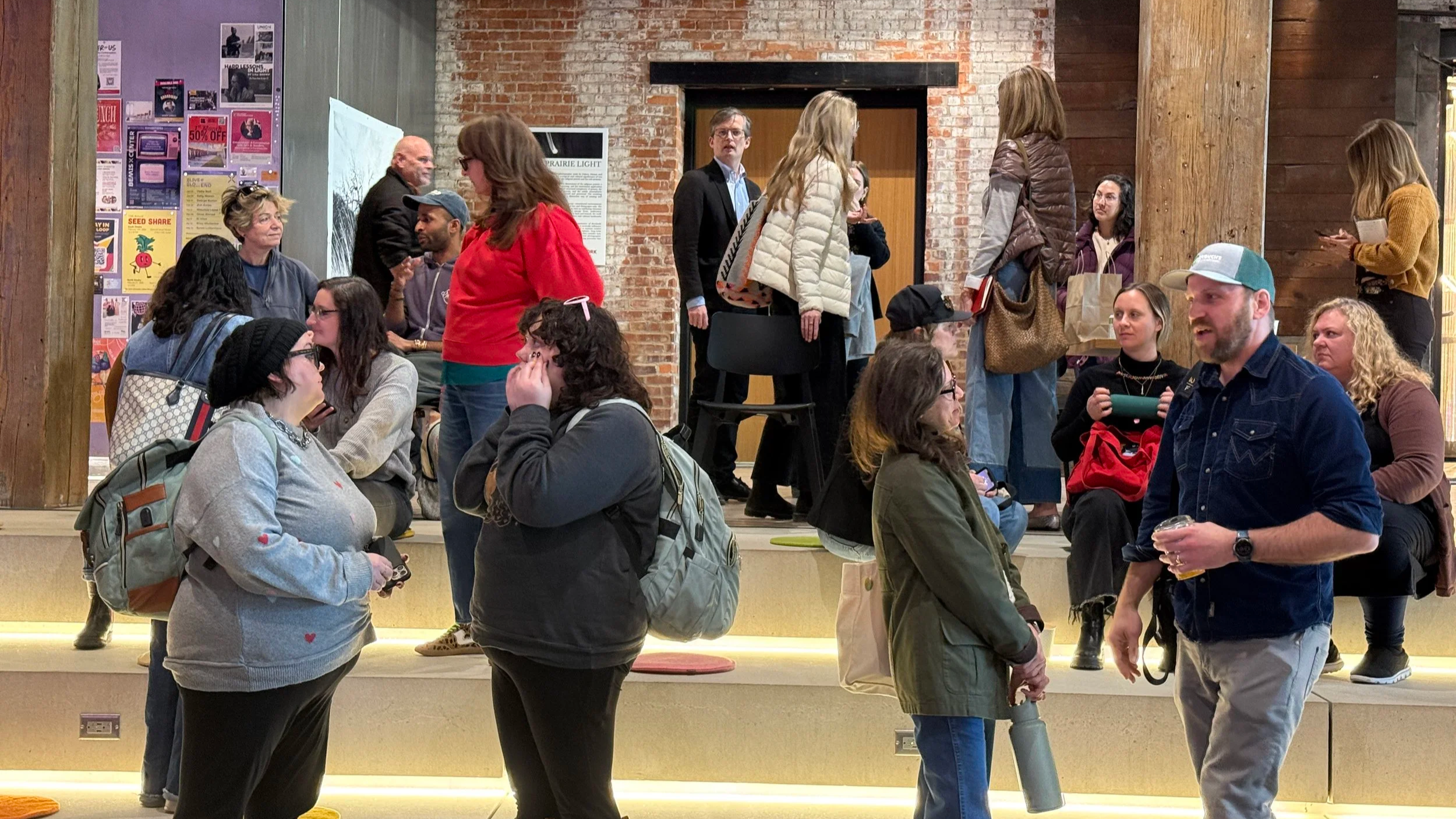
On February 13th, urban designer Manuel Cook and architect Megan Lutz sat down with Lauren Martin to talk about the evolution of planning processes and their cultural, spatial, and political implications on the role of public artwork in civic life.
Transcript
Title of Discussion: Ground Rules: Public Art and City Planning Transcript
Panelist 1: Manuel Cook
Panelist 2: Megan Lutz
Moderator: Lauren Martin
Date of Discussion: Feb 13th, 2026
List of Acronyms: [MC] = Manuel Cook; [ML] = Megan Lutz; [LM] = Lauren Martin
[LM] Thank you so much, everyone for being here. I'm Lauren Martin, and I oversee Partnerships at Amplify Arts. Amplify provides resources to the artists, cultural workers, and organizers who move our community forward.
Today we're talking about public art and city planning process, how they intersect, and how planning histories have led us to where we are. So, I think with that, before I introduce our two amazing panelists, I'm going to share a little bit of context. We've been thinking through the evolution of planning processes, how they have shaped the functions of public art over time. We want to trace that history because a lot of the time, it can be pretty opaque and not immediately evident. Our panelists today are going to help shed some light on those processes and how they’ve shaped the ways public artwork is placed, encountered, and interpreted within the built environment.
First, Manne Cook is joining us. Manne is an interdisciplinary urban design leader with nearly ten years of housing policy, real estate development, urban design, neighborhood & community development experience. He has a track record of launching and delivering district-scale infrastructure and placemaking initiatives that create more vibrant and liveable built environments - examples include founding the North Omaha Trail, Fabric Lab, and Fabric LLC, and leading area plans for North 24th Street and the Omaha Inland Port Authority. Manne was raised in North Omaha with deep roots in the community and has an expertise for aligning development, infrastructure, real-estate strategy, and cultural assets into implementable plans and capital projects. He has a knack for navigating complex systems and organizing catalytic collaborations that move projects from idea through strategic planning & design, funding, construction, and activation. He specializes in the planning and development of projects and initiatives that leverage community assets, art, history, and culture to create more livable, people oriented, environments of health & healing.
We’re very grateful to have him here with us today and equally grateful to be joined by Megan Lutz. Megan is an architect and Partner at Alley Poyner Macchietto Architecture. She possesses a comprehensive knowledge of all aspects of the design process, from master planning through building construction. She draws from a range of project and research experiences, including her time as a Fulbright Scholar at the Center for Public Space Research in Copenhagen. With a passion for Omaha, Megan takes particular interest in the revitalization of its central neighborhoods, through a thoughtful and strategic approach to urban design, planning and architecture that is driven by the needs of the city’s current and future residents.
Megan and Manne, thank you so much for being here. Can you both tell us a little more about your practices?
[ML] Hi, I'm Megan. I'm a partner at Alley Poyner Macchietto. My background is architecture, but I work with planning processes at all different scales from the macro level, the big picture, all the way down to the really fine details. And so, at Alley Poyner Macchietto, the mission is to put people first, which is one of the reasons I work there. That very much aligns with personal priorities. As a firm, we have a long history of working on projects in Downtown Omaha, East Omaha, North Omaha that use design as a tool to bring people together. There's been a lot of good work happening here for the last twenty years, but we still have both good and bad, like any city. Personally, I think about architecture in a way that removes the idea that a building is just an object sitting in isolation. I think about it as the sequence of experiences in and around buildings and what happens when people move in between those experiences, as opposed to just thinking about the buildings themselves.
[MC] I agree with thinking about buildings on a more human scale. I would say that my practice really focuses on what planning happens between the site level, the neighborhood level, and the district level, and how people-centered transportation like walking and biking can be a throughline. My background is really working with community to pull some of those pieces into the planning and design processes. Oftentimes, I think development and infrastructure projects can be too sterile. You need the cultural context that comes from the community to give projects texture and meaning.
[LC] Thank you for sharing that. You’ve both raised points about the connections between physical and social infrastructure and I think we all intuitively feel the historical influences of different approaches to city planning processes. Can you talk more about how the history of city planning has shaped perceptions of public art over time and consequently, general attitudes towards the role artwork should fulfill in public spaces?
[MC] Well, as I've been thinking about this, two things come to mind: spatial inequities and power-geometries, Doreen Massey’s idea that space and mobility are shaped by power differentials. So, when you think about public art, I think one of the questions is, who decided that this is the conversation that we're going to have. C.R.E.A.M. (cash rules everything around me), you know. Wu-Tang. I think that concept is really relevant in planning and design because you have to wonder, at the end of the day, who's paying for that artwork. Who's making decisions on what is acceptable in a particular space or place.
[ML] I’ll reiterate all of that and tie it to the historical context of planning processes and how art has fit into it. Planning from a spatial perspective, historically, has had some really terrible things come out of it in terms of how it addresses people from a very top-down view. I am an architect. I like planning and architecture. But sometimes architects risk developing this almost god-like mentality. They're like, “I get to dictate where the streets go. I get to dictate where these buildings are. This is how people should live.” As a modernist example, you know, at one point, Le Corbusier wanted to raise central Paris and build loads of towers, right? What a terrible idea, right? Thankfully, it didn’t actually happen, but sometimes that’s the approach. And so my thinking when about architecture projects relative to art is that they’re a framework or a scenario that invites participation from other people. I don’t want to be totally prescriptive about what should happen or how people should interact with these places. I really value working with partners who are comfortable staying open to what it could be when the architecture becomes a conduit for experience. That’s a powerful thing that can lead to public artwork manifesting in a lot of different forms if the architecture can serve as a kind of container.
[LM] Thank you for calling that out. As an arts organization that studies this, it's been fascinating to look at, for example, mid-20th-century modernist planning that reshaped cities to favor automobiles over pedestrians and consequently treated public art as an “add-on” in plazas, or corporate lobbies, or housing developments as decoration rather than as a spatial agent. Then you consider percent-for-art programs that emerged during the same period that institutionalized public art in a way, constraining it within bureaucracies that favor neutrality and durability over social engagement. All of those histories have compounded over time, and now artists making work in these spaces are charged with connecting the physical infrastructure to the social infrastructure that’s often ignored, like you both touched on. They also have to navigate situations where they have to be researchers, community organizers, and educators to make up for the lack of intentional planning in the past. So, pulling at that thread, how do you feel public artwork has been incorporated or neglected in ways that have significantly shaped how our city looks, moves, and feels?
[MC] I would say, thinking about Megan’s example of trying to knock down central Paris, Omaha kind of has the same issue and it has actually happened here. The textbook example is Jobbers Canyon, right? There’s this mentality that progress has to equate to building something new and knocking down what already exists to make room for it. I think it's important to rethink that approach and do things differently. What would an additive approach look like instead where we’re planning and designing with, or on top of, or next to you, what we already have.
[ML] Right, it’s like, “let’s tear down the buildings on these blocks because people have a negative perception of Downton and build a closed off corporate campus in their place. That’ll fix it.” All that did was create a more isolated Downtown and worse conditions for people who lived there, or worked there, or visited. The RiverFront park is a good counterpoint to that and an example of how planning can enhance civic spaces. We wanted as many entry points and opportunities for people to find and engage in this park as possible and we fit the art, whatever the subjective opinions of the individual works may be, into that context of building connection and multiple ways to encounter sculpture, video, performance, or whatever else.
[LM] That's so valuable. So do you feel as though contemporary planning and design processes are changing to acknowledge the expanding definitions of what constitutes public artwork?
[MC] I would say it's a back and forth. Sometimes we do a really good job of incorporating community feedback into projects and sometimes it’s more of a top-down thing. But beyond that, I think that art really asks the question “why.” And when you’re asking that question, you’re dealing with the history and the cultural contexts of a place. Planning plays into that really well because it gives you the opportunity to then ask, “well, what are we going to do with it?” I think that’s the important thing. If conversations around public art help us understand the “why” through the eyes of the community, and then that context helps us figure out what to do in terms of planning, then you’ll likely have a better, more holistic project.
[LM] I feel like what we're starting to touch on is how do we build a culture and a community that embraces and values art more broadly. So, I’m curious, what value do you feel that artists and artwork can bring to large-scale infrastructure projects in the city in an ideal scenario?
[ML] Assuming we have the ideal conditions set up, artwork can first of all get people–artists, developers, policymakers, architects–working together and building cross-sector collaborations. That’s in an ideal scenario and it’s not a simple task. The challenging thing about integrating impactful artwork into a large-scale infrastructure project is working to make sure it can respond to its context and function at the same emotional level as artwork in a museum or gallery or another container that already exists–one that you already know. In building projects it has to be part of the process from the beginning. It can't be somebody on the project saying at the last minute, “I think there should be a piece of art here.” In an ideal world, the more perspectives involved at the outset, the better the process for determining what kind of artwork can, and should, be included. Give stakeholders, including artists and arts workers that actually are involved in the art world, the opportunity to be a part of the project from the beginning.
[MC] I would just add to that, I think that large infrastructure projects present an opportunity to really embed history and culture into the built environment. How do you do that through advanced design? How can the project actually work with artists throughout the design process to tell history, and celebrate culture in a way that meaningfully recognizes the community. I think a lot of times what happens in big projects is that owners end up displacing communities, both physically and culturally. A context sensitive approach to incorporating public artwork into the process can help us recognize what is there, what has been there, and then embed those things to help keep communities from being displaced.
[LM] Those are great points. The reality is that it's hard to talk about what it could be in an ideal situation because we don't have an ideal situation. It hasn't happened.
[ML] Right. Everything is connected. This whole ecosystem is very complicated, but the ideal situation is a cultural shift in terms of how we appreciate art in general. We have to move beyond the definition of public artwork as an amenity and think of it as a tool for creating social connection. And, you know, putting up a plaque, or something, to tokenize the histories of a place isn’t the solution. It’s about how we adjust our planning processes to connect the artwork and all of the other planning areas in a way that will enhance how people use the space and understand its histories.
[LM] My next question was going to be if you could institutionalize policy at the city level that would help get to this point, what would it be? But I think maybe recognizing that policy doesn't equal a cultural shift, if there's any action or opportunity that you might offer instead, you can choose where you want to go with that.
[MC] So, me and Megan were on another panel for Amplify almost ten years ago. Maybe not ten years ago, but it was a while ago. I was thinking then, and I think about it even more today, one thing that is so relevant is more affordable housing. It creates spaces for artists and creatives and entrepreneurs of all types. I think more affordable housing is key and that it could help with a lot of things like more art and public spaces and creativity and innovation. If that were to happen, we might not have the brain drain that we have.
[ML] Somebody in the audience asked, “What if art was a TIF eligible expense?” I think that’s a good possibility and a way to make policy work for public art. That also comes with a lot of institutional bureaucracy that can favor more neutral artwork and less social engagement. The funding is great, but there’s also a risk of turning the artwork into just another box to check. The bigger issue is the ecosystem of how people live and work here. How do they afford to be artists? So, like Manne said, the most impactful policy changes at the city level are probably not going to be specifically arts related. Though, I still think arts-forward policy is interesting.
[MC] And maybe there’s some sort of overlap with historic preservation. I was working with a friend in the audience on a potential project, and then they knocked down the building. It could have been a really cool opportunity, not only for artwork, but it could have been a really interesting center point to a project. It was kind of a devastating one. But the people who owned the property couldn’t see anything other than a parking lot. Worse case scenario, right? So, I think we have to find ways to get ahead of that. Even if property owners don’t want the tax credits, or that sort of thing, we have to at least be able to help them understand the value of assets that already exist in communities by explaining their value is intrinsic rather than ascribed by somebody coming in from the outside.
[LM] Thank you both for acknowledging those connections between how the city looks and feels and how we attribute value to arts and culture. They really are so intertwined. And I think we’ve come a long way in the last ten years, but I’m curious to know if you could talk about your vision for public artwork in our city over the next five, ten, and even fifty years, if you feel like you can.
[ML] I think we have made a lot of progress. You know, we were just chatting before the discussion about the timeframe of these big infrastructure projects, like the new Central Library, for example. Project timelines are so long, so when you want to implement changes in processes you realize that because of the timeframe, it may not be possible for another 20 years until you actually begin to see those changes. And that’s a really difficult thing to deal with. It's also very difficult to evaluate projects over such a long period of time. As humans, we adjust so quickly, and we forget quickly. That's all maybe an excuse to say I don't have an answer to the question, but I do people in my field and in planning are starting to come around to the idea that there’s a lot of value in incorporating public artwork starting at the ground level, and not only big gestures like large-scale sculpture or murals, but on the scale of personal experience, individual wellbeing, community vibrancy, thinking more about how public artwork make those integral to spaces.
[MC] I think in five years, there’s some cultural planning that could happen to help identify in what directions we’d like to go more strategically. Hopefully, that leads to a broader recognition of how art in public spaces can shape our city and the people who live here, or who visit. I think affordable housing and accessible creative spaces are key to building that recognition. Maybe some policy changes that allow for more municipal support come after that. Then, in ten years, hoping that those fundamentals are there, I think other policies will kind of fall in place. In fifty years, I’ll be eighty. I don’t know.
[LM] Thank you for that. It’s really exciting to hear both of your perspectives about what’s possible in the future. I'm going to go ahead and open it up to questions.
[Audience Member] Hi, thank you all so much for this conversation. I'm an artist and an arts administrator and I have found after living in Omaha, and outside of Omaha, that there's a huge difference here in this city when it comes to processes for running public art projects. Most cities our size have a Department of Cultural Affairs, or something on that level and infrastructure that allows for artists to engage. Here, there’s nothing like that. Parks and Rec is responsible for overseeing public art projects.
When I moved back to Omaha many years ago, I was told, “Oh, if you want to encourage public art, it has to be privately funded, and it has to be driven by philanthropy,” and I thought that was a huge disconnect. And I'm just wondering, in your opinion, how do we go from all philanthropic dollars funding these projects to something that's more built-in and reliable?
[ML] Omaha has an amazing philanthropic community that puts a lot of money towards public resources. It’s an amazing asset to the community, but it also has influenced how public funding works and how public systems work, because they’ve evolved in response to where the money comes from. On top of that, as a public, we're very complacent about what sort of assistance our city is providing for us. I think, again, that’s where a mindset shift about the value of culture needs to happen so there’s more public discourse around these projects before, and while they’re happening, versus those kinds of handshake deals that drive a lot of the decision making that you're mentioning. So, you’re right. Commissions happen very differently in Omaha than in other cities. And philanthropy and generosity are so important and we’re lucky to live in a city with such a long history of giving, but on the public side, we have to be diligent about what we expect from our public institutions.
[MC] I agree with that, and I'll just add that we need both of those things. Regardless of who’s making decisions, how those decisions are made should be more transparent. You know, if you think of the flip side of what exclusively municipally funded projects would look like, it could look pretty boring. There’s a lot of red tape that comes along with city and state bureaucracy and that can sometimes limit how dynamic an artwork in public space can be because selection processes will favor neutrality over highlighting historical context or site responsiveness. So, whether projects are funded through private philanthropic dollars or funding from the city or state, there are pros and cons to both. I think the important thing is that we, as a public, ask for transparency so more people can understand those processes and make their voices heard.
[LM] I think what I’ve learned during my time working on public art projects through Amplify, and what this conversion has reinforced, is that it takes a lot of time and preparation, and conversation to make these things happen. We're so lucky to have all of this development in Omaha and resources to make it happen, but it can be a double-edged sword at times because we know that without public input, there’s limited buy-in for these big projects that really have the potential to enhance civic life. It's not perfect. We're not getting right every time. But that also means there’s a lot of opportunity to look more critically at how we can change.
Thank you all so much for being here and thanks especially to you, Manne and Megan, for sharing your thoughts and perspectives so openly. We’ll see you all soon.
*This transcript has been edited for length and clarity.
About the Panelists:
Manuel Cook (Manne) is an interdisciplinary urban design leader with nearly ten years of housing policy, real estate development, urban design, neighborhood & community development experience. He has a track record of launching and delivering district-scale infrastructure and placemaking initiatives that create more vibrant and liveable built environments - examples include founding the North Omaha Trail, Fabric Lab, and Fabric LLC, and leading area plans for North 24th Street and the Omaha Inland Port Authority. Manne was raised in North Omaha with deep roots in the community and has an expertise for aligning development, infrastructure, real-estate strategy, and cultural assets into implementable plans and capital projects. He has a knack for navigating complex systems and organizing catalytic collaborations that move projects from idea through strategic planning & design, funding, construction, and activation. He specializes in the planning and development of projects and initiatives that leverage community assets, art, history, and culture to create more livable, people oriented, environments of health & healing.
Megan Lutz, AIA, LEED AP is an architect and Partner at Alley Poyner Macchietto Architecture. She possesses a comprehensive knowledge of all aspects of the design process, from master planning through building construction. She draws from a range of project and research experiences, including her time as a Fulbright Scholar at the Center for Public Space Research in Copenhagen. With a passion for Omaha, Megan takes particular interest in the revitalization of its central neighborhoods, through a thoughtful and strategic approach to urban design, planning and architecture that is driven by the needs of the city’s current and future residents.
About the Moderator:
Lauren Martin oversees Partnerships at Amplify Arts. She has devoted her career to building, developing, and activating organizations that enhance our region. Most recently, in her role as Executive Director of Maha Festival, Lauren worked to support dynamic programming that meaningfully connected people from near and far with Omaha’s creative communities. Her role at Maha – as well as previous roles at the Omaha Community Foundation, Omaha Performing Arts, Hear Nebraska, Saddle Creek Records, and more – helped her understand the systems and structures that support our community’s cultural resources and Omaha’s potential as a place where artists can live, work, and find meaningful support.