
A Body is an Archive is a Quilt: Meredith Bacon and the Queer Omaha Archives
by Teresa Carmody
October 15, 2026
“I think of queerness as a temporal arrangement in which the past is a field of possibility in which subjects can act in the present in the service of a new futurity.”
-José Esteban Muñoz, Cruising Utopia
I tell people I’m writing about Meredith Bacon and they tell me they knew her. “An icon!” says my colleague, Todd, which is true, so I’m both surprised and not that I’ve only recently clocked Meredith Bacon as a person of significance not just in Omaha but nationally. In 2005, political science professor Dr. Meredith Bacon became the first UNO professor to publicly transition; she was, it seems, also the first transgender person in the United States elected Senate Faculty President, serving terms both before and after her transition. Her story was covered by the Omaha World Herald and picked up by the Chronicle of Higher Education, People magazine, and ABCNews.
For context: In 2005, Brokeback Mountain was released in theaters, and while Ellen had been out for eight years, many people still referred to Brandon Teena, a trans man murdered in Nebraska in 1993, as a woman “living as a man.” It had only been two years (2003) since the Supreme Court invalidated state laws that criminalized same-sex sexual activity and four years (2000) since voters in Nebraska passed Initiative 416, which banned same-sex marriage, same-sex domestic partnerships and all “other similar same-sex relationship(s).”
That Meredith Bacon publicly transitioned in Nebraska made her story national news.
“I knew her and her wife,” says Ana, a retired UNO professor who’s taking my class as a Senior Passport Learner. I’m sitting with Ana in the Criss Library Archives and Special Collections as students leaf through manila files in the boxes I’ve asked Claire, the Outreach Archivist, to pull from the vaults. I want students to get a sense of what they can find in the archives, requesting material that might intersect with their interests and experience. There’s an actual brick from Omaha University’s first building, zines and oral histories, Depression-era diaries, and a box from the Omaha Magical Society. We carry stories of the past within us—our individual recollections but also the collective story of who we are and where we come from. That “we,” of course, is contested. Am I talking about humans, Nebraskans, citizens, not “them”? In the archive, we encounter primary sources, some of which have been woven into publicly available stories, or stories we think we know. But much of it has not. The archive destabilizes the present tense. You start to see how a story could be differently told. Or untold. To ask: What else might be imagined?
Like how in 1993, Nebraska Governor Ben Nelson wrote a letter to the International Gay Rodeo Association urging the organization to come to Nebraska. Which they did. The Heartland Gay Rodeo Association established itself in Papillion, held its first rodeo in 1997, and for eleven years, raised funds for LGBTQIA+ and AIDS organizations. Finding this letter in 2024 blew my student’s mind. “There was a gay rodeo in Nebraska,” wrote Sarah Hayden in an essay for an earlier iteration of this class. “The same Nebraska where our governor still supports a bill that would restrict transgender students from participating in high school sports and limit their access to locker rooms and bathrooms.”¹ That a Nebraska governor had supported queer community means that a Nebraska governor can support queer community.
José Esteban Muñoz describes queerness as a utopian formation still on the horizon. Queerness meaning: I’m done trying to fit into capitalist-hetero-patriarchy and am prioritizing relationships instead—with each other and other species, with the past, with younger selves, with desire and imagination. Marriage is one way to organize your desire. But so is making praying mantis masks from paper-mâché and dancing with the Legion of Local Lesbians in the Benson First Friday “handmade” parade. “They really responded to us!” said my girlfriend, Jill, who codes as masc, so bathrooms are often an issue. But dancing as a congregation of praying mantises, the spectators were thrilled, smiling approval. It was strangely nourishing. We’d named ourselves after the Lincoln Legion of Lesbians (LLL), a group of radical lesbian activists recently celebrated in Sinister Wisdom. Three of the original nine LLL members, Morgan Grey, Moni Usasz, and Debbie Alicen, wrote about Lincoln as “a hotbed of lesbian political activity” in the 1970s and 80s. They could piece the story together, they note, because Barbara DiBernard preserved the LLL files, donating copies to the Nebraska State Historical Society while the originals are in the Lesbian Herstory Archives in New York City.
“Barbara DiBernard,” says Jill. “I knew her!”
“Queerness itself,” writes Muñoz, “is intensely relational with the past.”
I bring students into the library’s Special Collections and Archives so they can actually touch the materials there, feel mimeographed pages from the 1970s or run their fingers over small indentations in a depression-era diary. Touch crosses barriers. “To touch,” writes Lou Florez, “is an incantatory verb, the locus where unseen entities make themselves felt.”² When I hold Donna Cartwright’s³ email to Meredith Bacon, I feel the presence of both women, the intimacy of their correspondence. An intimacy extended, via the archive, to me.
There’s also an intimacy, differently felt, with materials that have been digitized. I can encounter these files more easily—on my computer at home or as audio/video recordings streaming directly into my ears. This is the intimacy of accessibility, the way an archive, as an institution, makes its collection more welcoming.
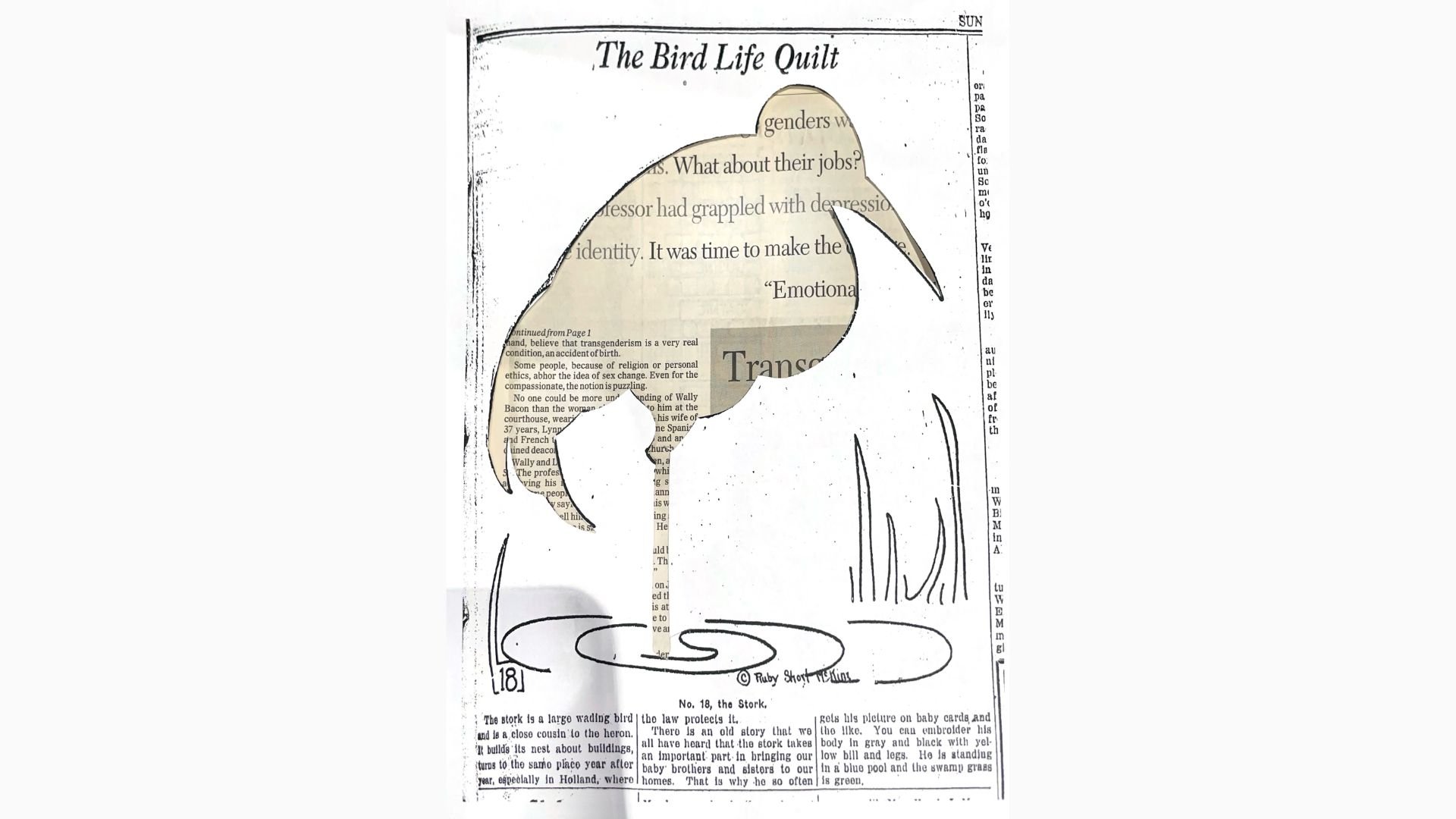
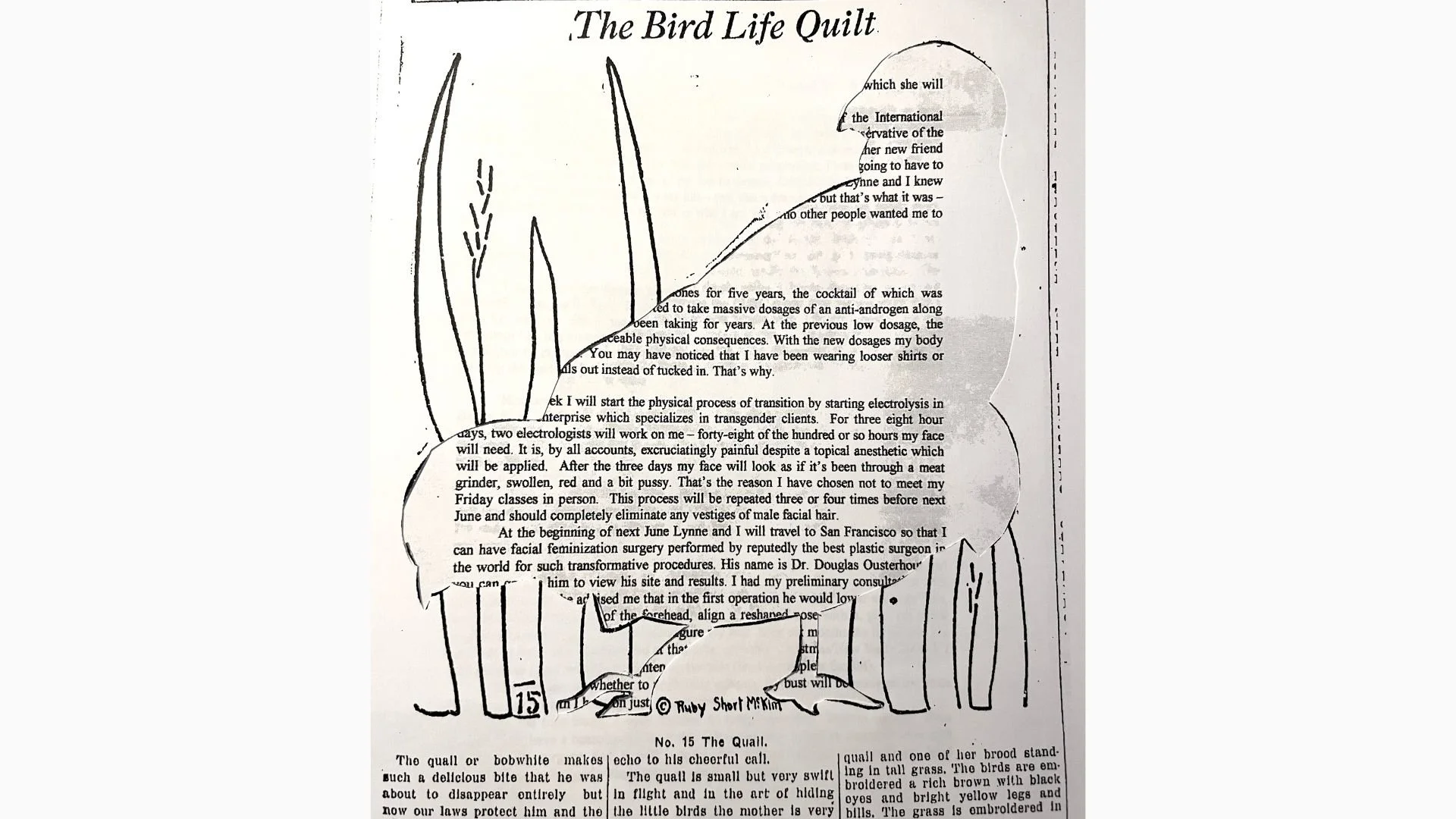
And I’m still trying to figure out Nebraska, so I wanted to essay together items from two Omaha archives: the Omaha Public Library (OPL) and the Queer Omaha Archives (QOA) at University of Nebraska Omaha. Two public institutions, who in turn shape the kind of public we can and might become. I find a public library finding aid for quilt block patterns that were printed in the Omaha World-Herald from the 1920s through the 40s. The patterns were designed by McKim Studios and, after 1938) newspaper staff artists. OPL has also digitized the newspaper, so from the OPL website, I print the Audubon “Bird Life” quilt pattern, 1929-30.⁴ The birds especially interested me because I love birds and birds often represent spirits and birds are increasingly threatened and of course there is the spring migration of sandhill cranes on the Platte River, which turns Nebraska into a destination for so many global travelers. Come for the birds, stay for the queers. Sounds like the Good Life to me.
But there’s more: Peter, my editor, tells me that sandhill cranes are monomorphic, meaning the males and females look the same. Androgenous, we could say, or “total queers!” writes Peter. The male cranes may be a little taller than the females, but that could change: with diet or time. With what pesticides are regulated, or not, and with the now constant threat of habitat loss. Sandhill cranes used to dance on my yard in Florida. But twice now, on the Platte River, I’ve witnessed hundreds of thousands of birds, resting and eating before they continue their migration north. A migration that has been happening for millions of year. An archive in motion.
Quilts, traditionally, are one way to keep a family archive. Especially in the Midwest. I have a pinwheel quilt that an auntie made from fabric scraps—like you did during the Depression. Repairing this quilt over the years, I’ve added fabric from a dress my mother wore as a little girl, from an old shirt by a friend/girlfriend who taught me about lesbianism, from a blouse I wore in my 20s, going to the club on Sundays for 80s-night, code for filling the club with queers. I met my first girlfriend there. A quilt is a way to bring materials from different times and bodies into proximity with each other.
In cross-stitch, the backstitch is sturdy, loopy and recursive, while the straight stitch: notoriously flimsy, ready to sag.
I taught a version of this class in Spring 2024; evidently, I asked Claire to pull a box from the Meredith Bacon papers then as well. Sometimes we don’t notice something until we need to; other times, we don’t notice until we can. Often, the emotional need exceeds the brain’s ability to cognize. I’ve felt how trauma floods the body, hijacks my nervous system, limits perception. I’ve also felt white privilege smog my body, limit my perception, ambush good intentions. I studied creative nonfiction in grad school because I didn’t think I had an imagination. I’d been raised inside a story of white Evangelical American exceptionalism with a soon-to-come rapture; I learned that to perceive differently, to imagine elsewhere, was to sin.
But when you deny your own desires and life force, you also deny real connections.
In Spring 2024, I was still in my first year at UNO, new to Nebraska, excited to be teaching at an institution that included the Queer Omaha Archives as part of its collection. I’d moved here from central Florida, and before that the West Coast, where I’d taken the queerness of Riot Grrl and the art scene for granted. But central Florida was so isolating that events moving online during the pandemic actually helped me feel less alone. On Zoom, people posted their pronouns, too. At first, all the pronouns made me angry. I didn’t want to merely virtue-signal. And I definitely did not want to write “she/her.” Don’t lump me as a femme. But because I also wanted to support my trans and non-binary students, I got curious about my anger. Talked with friends. Realized I’d been saying my dog has they/them pronouns, when it was a them I wanted. What did Gertrude Stein say? I know who I am because my dog knows me. Well, my dog is de la Fabulosa and I, too, am gender queer.
Florida was hard, but there was the ocean and the everyday green theater of the swamp. For better or worse, Florida has a reputation—people outside the state recognize that you live somewhere. But Nebraska?
I grew up in western Michigan, was pleased to have left the Midwest in the early 90s. I’ve come to know Omaha, and the Midwest, as much more than bogus stereotypes of flyover country, including middle-of-the-road Midwesterners. It’s strange, but I’ve been backstitching parts of myself together, too. I hadn’t realized that my dilly-dallying while taking leave was a Midwestern goodbye. Or that my earnestness could be so earnestly appreciated.
At orientation in Fall 2023, I was excited to learn about employee-facilitated affinity groups for UNO faculty and staff, including Black@UNO, First-Generation Guild, Disability Alliance, a LGBTQ+ group. In the archive, I learn just how new some of these groups were, presented only that spring by the Office of Diversity, Equity, Access and Inclusion (DEAI) as a way to positively impact campus culture. By the end of Spring term 2025, the groups were gone, the DEIA Office shuttered, staff fired.
But in the late 90s, Dr. Bacon, along with approximately thirty others, including a university administrator, showed up at a dorm to help a gay male student move because he was being harassed by other students in the building. And when the harassers began harassing the helpers, the helpers stared them down. I know this story because in 2016, Dr. Jay Irwin interviewed Meredith Bacon for the Queer Omaha Archives.
An interview that happened because people cared enough to quilt this history together.
It started like this: In 2015, following a visit by Joshua Burford, Invisible Histories Project, a group of UNO students, faculty, and librarians initiated the Queer Omaha Archives. They wanted to collect into the gaps of the communities they serve, understanding, as Angela Kroeger and Yumi Ohira wrote in blog post for the Society of American Archivists, that while UNO had become a LGBTQIA+ positive campus, “the lack of LGBTQIA+ materials in our university archives and special collections became recognized as a glaring silence.”⁵ To not collect the stories of minoritized groups is to render their history as insignificant or worse, non-existent. An archive is never neutral. Whose voices are gathered in the archive and who gets to access it. Who says what stays and what goes and how you’re allowed to use it? I can read Meredith Bacon’s papers because UNO community members, including administrators, prioritized creating the Omaha Queer Archives. Keeping the collection in Omaha means local people can access it. As Jacques Derrida writes in Archive Fever:
“There is no political power without control of the archive, if not of memory. Effective democratization can always be measured by this essential criterion: the participation in and the access to the archive, its constitution, and its interpretation.”
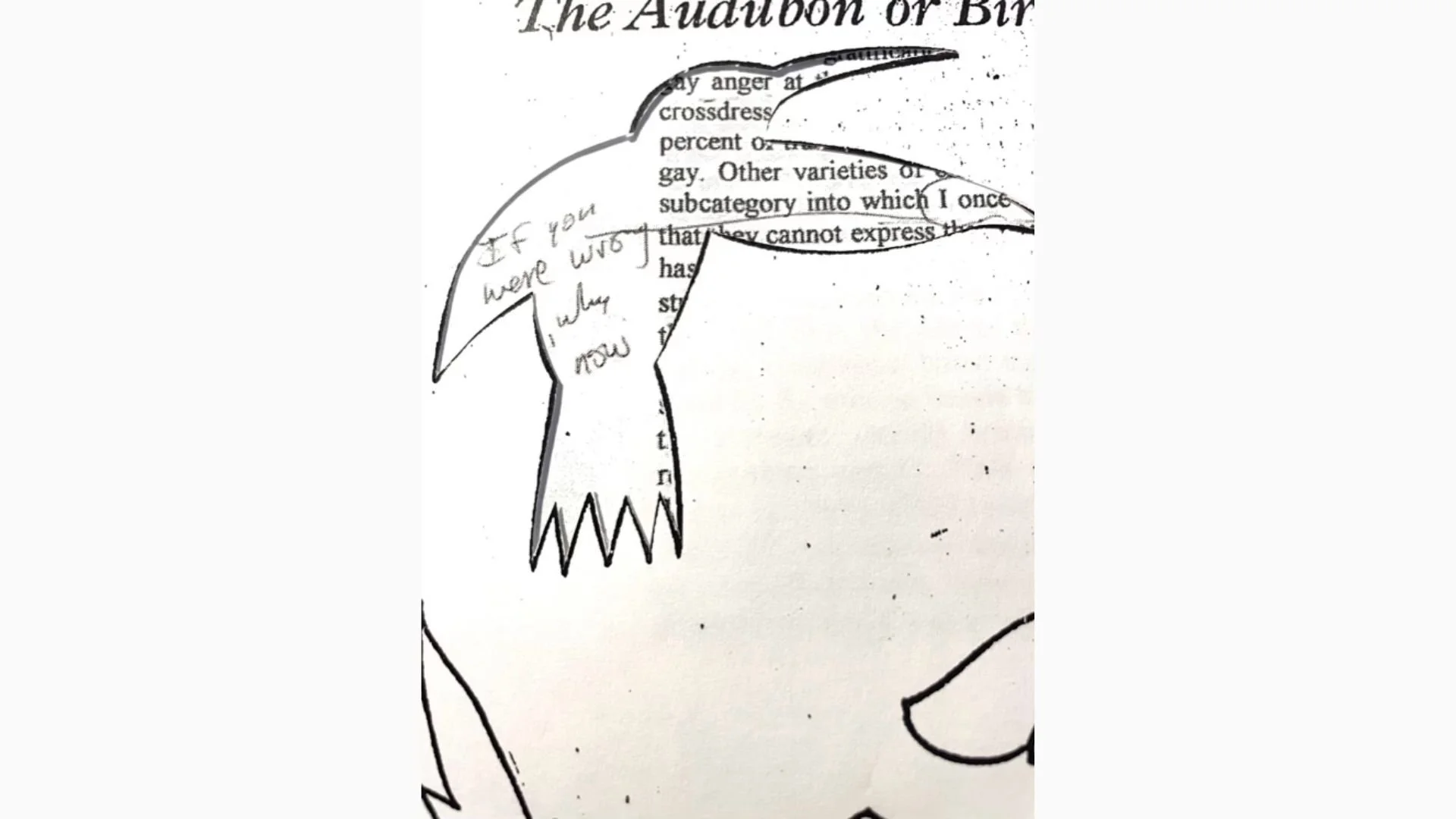
Meredith Bacon was an early donor to the Queer Omaha Archives. Her papers include research, newspaper clippings, photographs, her decree of name change. There is correspondence, so many letters from people around the country thanking her for publicly sharing her story. There’s so much that she wrote, including a draft of the six-page letter, annotated with corrections and notes, she addressed to her UNO colleagues. She prepared for this moment by working with a group of trusted friends and advisors: her endocrinologist, her therapist, two colleagues from her department and two colleagues from the college, a union representative, a supportive priest from her church, and her wife, Lynne. How do you shift the frame, create a new story so others can download the updated version of you, meet you there. Call them in.
“People liked Wally,” says Meredith in her interview with Jay Irwin. And liking Wally makes it easier for people to like Meredith. It also means she has more social connections to lose. As her friend, Sally Sparks, wrote in a letter about her transition: there was a “swift and absolute abandonment of most of our friends.”
Meredith’s “Dear Colleagues” letter does a lot of work. She writes about her medical diagnosis and offers some queer education and history. She addresses theological concerns and how she makes sense of herself within her Episcopopalian Christian faith. There’s also her personal life, her marriage, her body, what procedures she is planning and what is up in the air, pending legal issues. She anticipates her colleagues’ questions and assumes the emotional burden of answering them, in advance. She opens her private life to their scrutiny so to get ahead of rumors, speculations, and, perhaps, lost relationships.
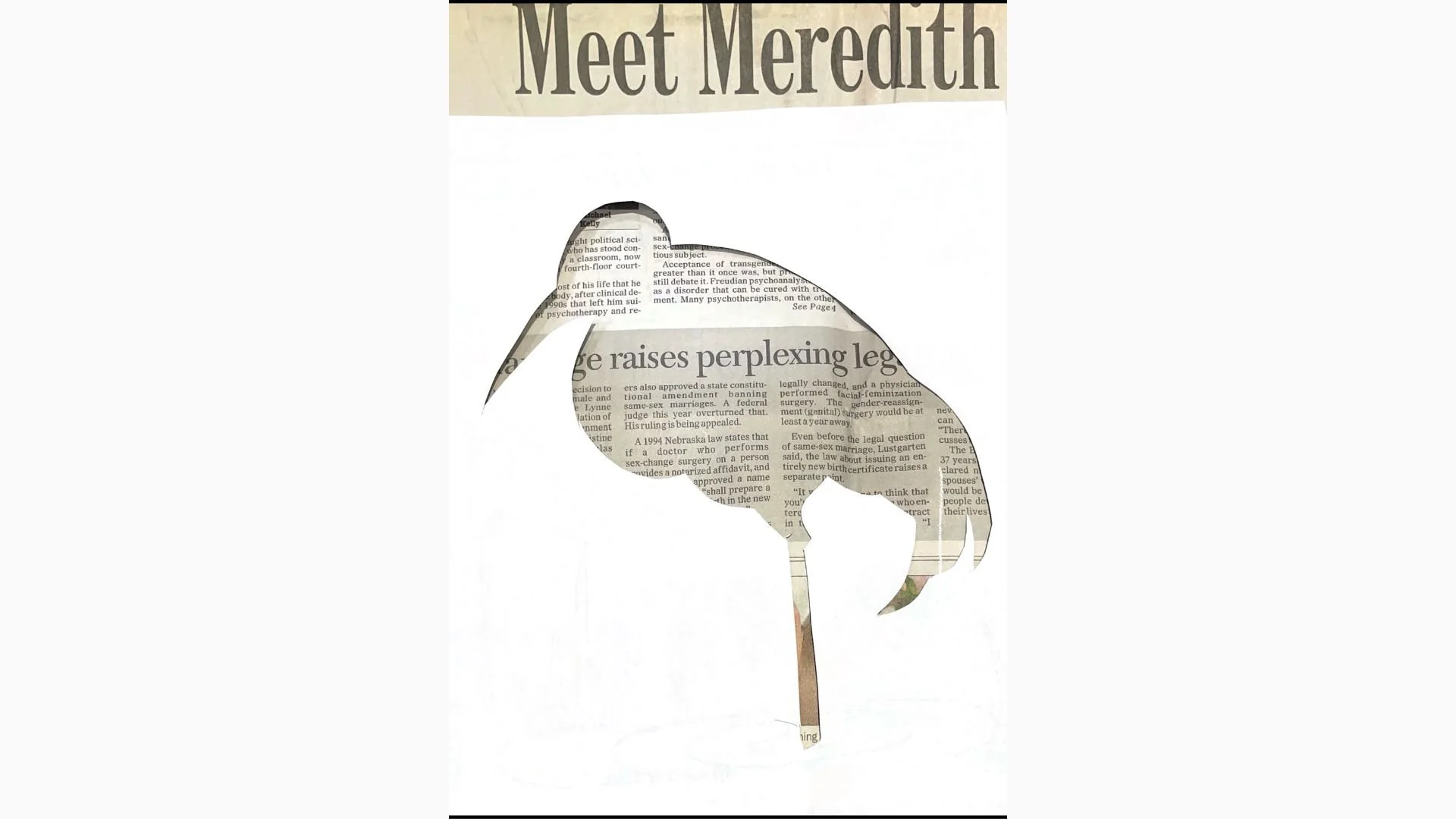
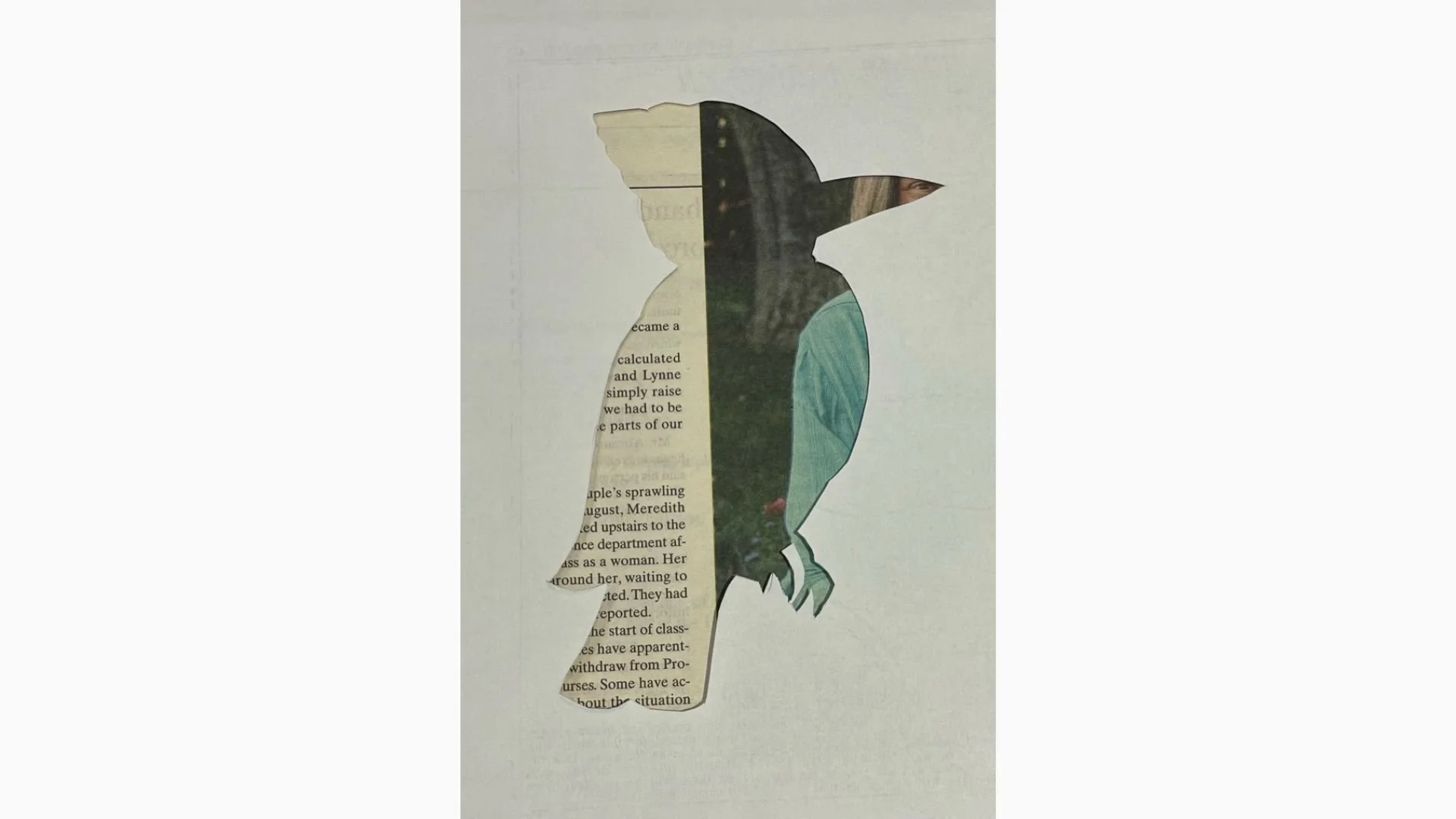
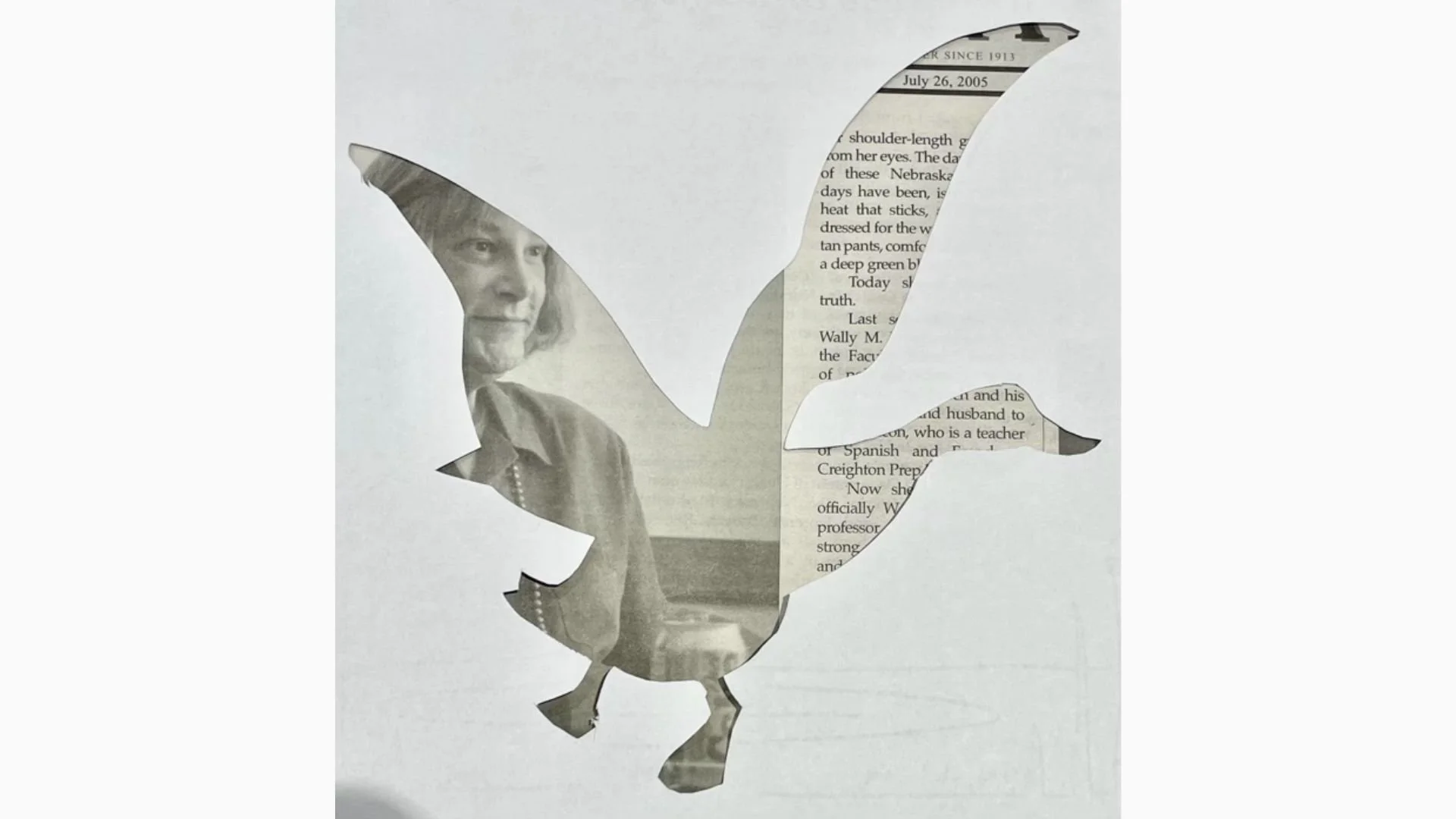
What happens when I overlay quilt pattern shapes over materials in the Meredith Bacon papers. What and how does this shifted frame make visible? The birds allow some words to come into focus, while others remain covered. Still there.
The archive becomes a site for backstitching the past toward the future.
End Notes
¹ Hayden, Sarah. “My Rainbow Connection,” Archival Findings: blend them into a life and you’ve got art. UNO Writer's Workshop Creative Nonfiction Studio, 2024, 2024-041, Box: MISC-16, Folder: UNO-0128.2024-041. UNO Writer's Workshop Records, UNO-0128. University of Nebraska at Omaha, Dr. C.C. and Mabel L. Criss Library, Archives and Special Collections.
² Florez, Lou and Teresa Carmody, The Demon Thread, video, forthcoming.
³ Learn more about Donna Cartwright and her activism at the NYC trans Oral History Project: https://nyctransoralhistory.org/interview/donna-cartwright/
⁴ https://omahalibrary.org/historic-quilt-blocks/
⁵ Kroeger, Angela and Yumi Ohira. “The Top 10 Thins We Learned from Building the Queer Omaha Archives, Part 1 – lessons 1 to 5.” Bloogers! https://saaers.wordpress.com/2018/11/06/the-top-10-things-we-learned-from-building-the-queer-omaha-archives-part-1-lessons-1-to-5/
Teresa Carmody (she/they) is the author of four books, including A Healthy Interest in the Lives of Others (2025) and The Reconception of Marie (2020). Raised to believe the Bible as factual history and queerness as a lie, Carmody’s writing troubles the line between fiction and nonfiction, and questions of spiritual abuse, trauma, queerness, friendship, and art. Their writing has appeared in LitHub, Los Angeles Review of Books, Michigan Quarterly Review, Agency 3: Novellas, and more. A co-founding editor of Les Figues Press, they currently teach fiction and creative nonfiction at University of Nebraska Omaha.