
Situated Selves: Art, Place, and Identity
Panel Discussion
December 12, 2025
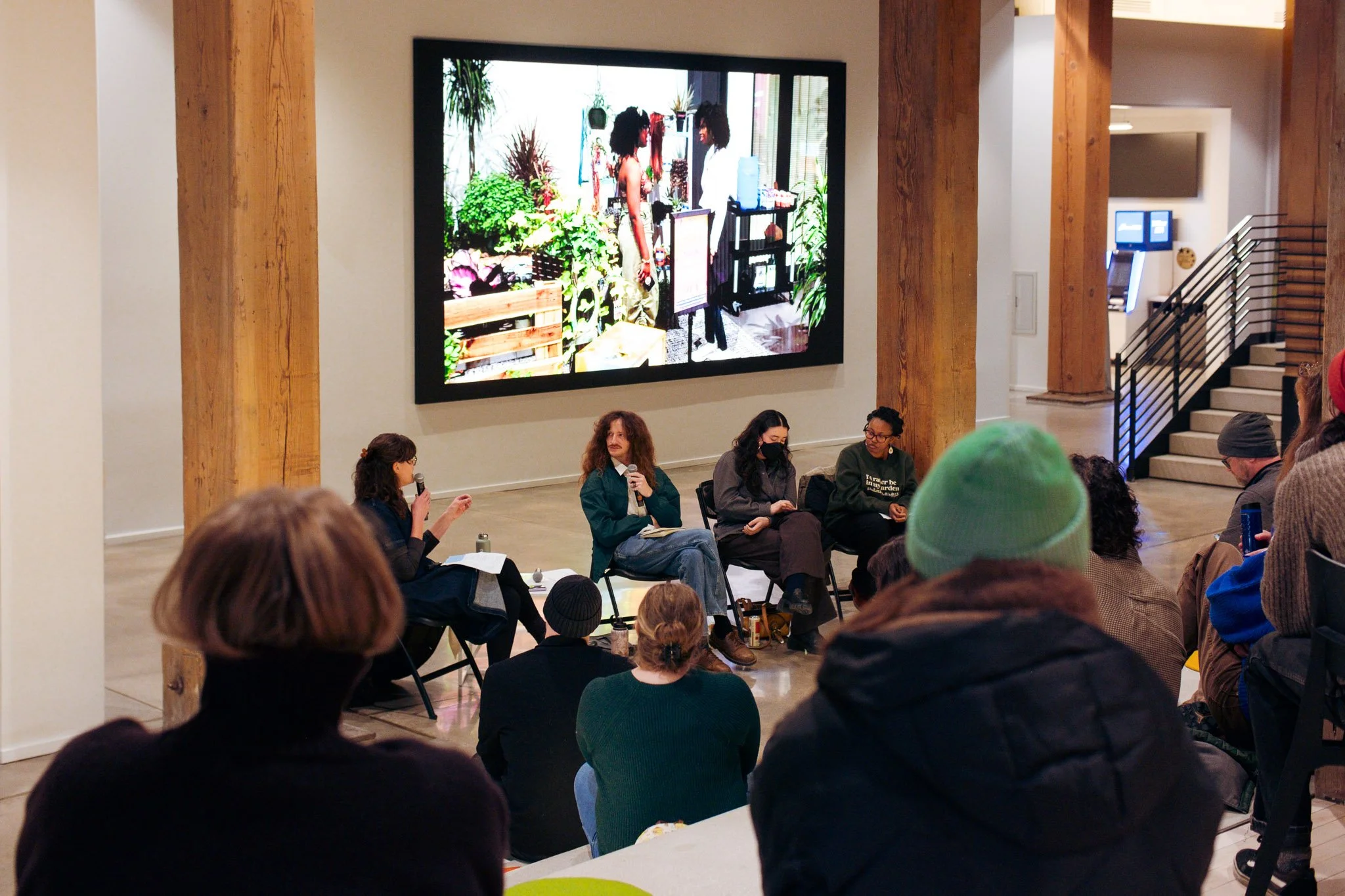
Sara Jacobson, Keegan Dunn, Cady de la Cruz, Ami Polite (seated in front from left to right)
On December 12th, Cady de la Cruz, Keegan Dunn, and Ami Polite sat down with moderator Sara Jacobson for a conversion about how environmental histories, cultural inheritance, and our ties to the land shape creative subjectivities.
Transcript
Title of Discussion: Situated Selves: Art, Place, and Identity
Panelist 1: Cady de la Cruz
Panelist 2: Keegan Dunn
Panelist 3: Ami Polite
Moderator: Sara Jacobson
Date of Discussion: December 12, 2025
List of Acronyms: [CC] = Cady de la Cruz; [KD] = Keegan Dunn; [AP] = Ami Polite; [SJ] = Sara Jacobson
[SJ] Hi everyone. Good afternoon. We’re happy to see you all here. I’m Sara Jacobson and I am thrilled to be here as a moderator today with this awesome group of people. To start with a brief intro: I moved back to Omaha in 2020 after living in in Chicago, New York, and Los Angeles for several years. My work in design research took me to all of those places and since I’ve moved around a lot, I’ve become very aware of how the different aspects of a place inform how I relate to the world. Since moving back to Omaha, I’ve become very interested in native plants, landscape design, and our region’s ecology.
So that is a little bit about me and I’m excited to talk with our panelists who share some the same interests and insights into how the places we live influence the memories our bodies carry and the cultures we inherit. Keegan Dunn is working at the intersection of both art and ecology. Cady de la Cruz, a recent transplant from Virginia is a cultural anthropologist and the Curatorial Assistant of Native American Art at Joslyn Art Museum. And Ami Polite is a gardener and author. Would you all introduce yourselves and talk a little more about your work?
[KD] Hello, everybody. Thank you. I’m Keegan and my work, like Sara said, is very focused on studying on documenting the ways people interact with ecosystems across the Midwest. I would say that my ecological art journey started by playing with my friends on the river. Play is probably the way that a lot of things start in practice. And this kind of photographic journey, documenting how people interact with the landscape, has raised a lot of questions for me. I've become fascinated by the history of our landscape, how we’ve shaped it, and how it shapes us.
[CC] (Cady introduces herself in her language). Hi everybody. Thank you for having me. I’m happy to be here. I started by introducing myself in Quechua, the ancestral language of my people. Quechua has taught me a lot about our cosmologies with the views of the world and our identities alongside the land. As Sara said, I currently work with the Native American art collection at the Joslyn museum. I spend a lot of time working with community and it’s an honor to work with my relatives and care for their cultural belongings in that way.
[AP] Hello, I'm Ami Polite, and if you can read my sweatshirt, you’ll see I’d rather be in my garden. I've been in Omaha since 1995. I'm originally from South Bronx, New York and I’m a self-taught horticultural facilitator. I got my start working with plants volunteering at Lauritzen Gardens and after a couple years of working there, I’d learned a lot and became a private gardener in 2010 with clients all around the city, mostly helping older gardeners take care of their landscapes. And with that, gardening and caring for plants helped me get more comfortable with myself and my hair, and I saw the comparisons of taking care of your hair and taking care of your plants, so I wrote a book about it called, Garden My Hair.
A lot of the visual imagery in the book pulls from tagging and graffiti because for me, growing up in the South Bronx, that was my first art that I saw. Graffiti artists are some of the most talented people in the world, in my opinion. I was born in the 70s and my brothers were older, so they were teenagers when hip hop started in the Bronx. And so, I was surrounded by kids who didn't go to art school climbing on trains, climbing on buildings in the middle of the night making murals, making their work. As an adult, I find the same type of wildness and ingenuity in the landscapes I work with. Both graffiti and gardening ask people to get outside and become more aware of their environments
That’s important because it helps people reconnect. A lot of people have lost their connection to the land and they're trying to find a way to get back to that. My work purposely places people in natural spaces to help them reconnect with the plants that are part of their histories, the plants that remind them of themselves, and the stories and situations connected to the land that have made them who they are.
[SJ] Thank you, all. Amy, your point about education is really interesting because I think all three of you have that woven into the work that you do. Keegan, can you talk more about what you are learning and understanding through your work with the landscape and what you see other people learning while interacting with their environments?
[KD] Well, I would say that I have a kind of complicated relationship with education. I feel like a lot of the ways I think about learning, and my approach to learning, don’t have a lot to do with the type of formal education you get at a college or university. There are all sorts of cues about the world that you pick up and maybe the process of understanding is so linear. Conversations with other people about how they relate to the land spending a lot of time outside feeling the wind or rain or heat or cold or whatever the day brings builds a more intuitive understanding of a place and the people in it. Curiosity is the best teacher, think. And going through academic programs while valuing the things you learn outside the institution has helped me understand that making informed decisions about the places we're building and the environments we're a part of requires a more diverse cast of people because the type of knowledge we need to make those decisions more thoughtfully is produced in many different ways, not just within an academic structure. I made a series of photographs, just for an example, using the tannins in the bark of the Eastern Cottonwood as chemistry. I also recently did a deep dive into natural dying techniques, and a lot of that work is experiential and happens by playing around and through experimenting with different materials.
[CC] In terms of education and interpreting our relationships to land, I think it’s really important to look at materials and all the invisible histories they hold that tell us so much. With the Joslyn’s collection, there are so many objects that were acquired by white people who didn’t have a good understanding of the significance of the materials that were used to create them. What went into the tanning of the hide or making the sinew to sew beads? I think there’s a responsibility to teach people more about materials, because they’re such an important part of how we relate to the land that’s often ignored in Western cultures where land is very separate from art.
I think even in my own traditions, things that I grew up around, like textiles. There's so much that goes into raising the animals for the fibers, and even beyond that, in the thousands of years of domesticating animals to breed for softer fibers. The Quechua root for land is “pacha,” which we use to talk about the soil, the land, the dirt, but we also use it as a philosophical complex of its totality, its outside space and time so those separations disappear in order to properly appreciate and understand the generations of relationship to land that we see in Indigenous art through materials.
[SJ] Those are really wonderful insights. Thank you both. Amy, you talked a little about using your practice to encourage people to reconnect with land. Would you share more about that?
[AP] Well, I call them “botanical breaks” and they’re short, 15-to-20-minute breaks just to be in nature. Most of office spaces today kind of enclose folks and maybe they work close to snake plant or, a ZZ plant, but that’s not the same as being outside. Even if it’s just for 20 minutes during the workday, it makes a big difference.
My dad, who passed away many years ago, grew up in the South Bronx, people on top of people, on top of people. Growing up there, he still found a way to make sure that our apartment building was directly across from Crotona Park, which basically the Bronx’s Central Park. I was constantly in the park. My parents made sure that we were outside all the time, no matter what the weather was doing and that’s where a lot of my appreciation for plants comes from. You know, they can heal us and they can poison us just as easily, so you have to respect them. And you don't have to be a horticulturalist, or a botanist, to appreciate that. As humans, sometimes we forget, we are part of nature too. I think we’ve gotten to this point where we forget we a are very, very small part of a much larger system. We’re a part of it, but we also depend on it, and we need to respect it.
[CC] When I was living in Virginia and going to college there, I started became friends with a lot of foragers. I learned so much from them about different plants’ personalities. You know, like for example, certain plants have adapted to grow tough spikes to protect themselves, like the locust tree. Plants have migration stories too that are linked to the history of colonization in this country, you know, colonizers worked to eliminate so many plants from the land that Indigenous people relied on and still rely on. The history of plants, cultural identity, and survivance are all tied together here. That’s just a little addition.
[SJ] I would love to talk more about that. The land has given to us, we take from the land, we can also give back and live in that reciprocity, too. The dominant narrative we see in reporting about climate change, for example, frames human activity broadly in a pretty negative way without accounting for the reality that people living in the Global South, Indigenous people, bear far less responsibility for rising carbon emissions. We know wealthy westernized countries, their militaries, and cultures of consumption are disproportionately driving emissions. So, thinking more about what our responsibility is in that, and the reciprocal nature of what we can give back, I'm curious about how you all think about reciprocity in the context of your work.
[KD] That’s a good question and I think it registers on so many different levels, especially given we live in a very privatized state. That means there’s less enforceable regulation and a lot of decisions about what our relationship to the land looks like rest in the hands of very few people. That part is unfortunate, but it also presents some possibilities to share responsibilities for caring for land in smaller ways that collectively add up. That’s my take on something I see as a negative. I think about how we can empower ourselves to challenge private land use by touching the land and being with it even if it doesn’t “belong” to us. It’s our responsibility to collectively care for the land. That responsibility belongs to all of us.
I think it's easy to get stuck thinking, I want to make a difference, but I need a special education, or money, or influence. And I would counter that by saying that it's everybody's responsibility to be as active a participant in land stewardship as they'd like to be, whether that means becoming a citizen scientist and logging changes in your ecoregion on an app, or volunteering with a capital “C” conservation organization, or ameliorating the soil in your backyard, or joining a community garden. All of those things help build broader consciousness around how we build relationships with the land. Even if they feel small or insignificant, they’re not. They matter.
[CC] I’ve been thinking about ecological ethics and our ethical responsibility to respect the intrinsic value of non-human beings and what that means. And the answer that comes to the surface for me is that protecting Indigenous sovereignty and protecting the land defenders matters most. It seems like sometimes white environmentalism and western approaches to conservation are more concerned with a donor class, or money passing through a 501c3, or lobbying in congress, rather than supporting the stewards of the land itself. They reality is that communities on the front lines are working class. In a lot of places, in many countries, land defenders are categorized as terrorists. Dozens of land defenders in Latin American countries, including my own, are murdered every year. People are putting their bodies on the line for the land. There’s real reciprocity in that. Look at Standing Rock. People are still imprisoned to this day after having participated in those protests.
And so, when I think of my ethic, it's mostly about throwing sand in the gears of the system. When I was in school, I was a part of a lot of pro-Palestine activism going back to 2022, when a group of students began protesting the university’s affiliation with Zionist agendas. And so many progressive people at the University disparaged us. After October 7th, 2023, that escalated while we continued to build coalitions across campus. We went through all of these acceptable pathways and official channels to get the University to withdraw its investments in companies doing business with Israel, especially businesses supporting its military or settlements in the West Bank. And for me, that’s an example of environmentalism that engages with ethics. Just look at all of the studies that quantify carbon emissions of direct war activities. The emissions that came from Israel’s 15 months of military assault in Gaza were greater than the individual annual emissions of 36 countries and territories. To me, that kind illustrates how staying connected to the land, to the places you’re from, influences the ethical responsibilities that shape who you are and how you position yourself in the world.
[SJ] Thank you all so much. I think we’re at a good place to open up the discussion and take some questions. Anybody in the audience have a question?
[Audience Member] I'm Barbara. I'm a professor and a Native American literature specialist and I’d like to ask, thinking about a bigger category of relationships with plants, can you to address plants and power? I’ve been thinking about Leslie Marmon Silko’s Almanac of the Dead. In the book, she writes about the gladiolus as a symbol of colonial power. In the classroom, I've seen some oblivious attitudes towards how plants can project power and identity, and I wondered if any of you had thoughts about that.
[CC] I can jump in. The people who taught me how to forage in Charlottesville were also community organizers. They were survivors of the white supremacist march on August 11th and 12th of 2017. And they had moved out of the city to rural Virginia to found a space where organizers could go and work together. I’d say most of the lessons I learned there about plants were related to what you’re talking about. They were either projecting power, or they were survivors, or they had a different story to tell. We would learn about migration stories and how plants and people share migration stories that you can’t separate from the history of colonialism. In rural Virginia, free Black folks were farming and building communities for generations and generations, going back to Jefferson's time. The plants they cultivated also tell the story of diaspora. Even what we might consider invasive plants, you know, how did they get here? Did they ask to be here?
[AP] When I think of plants and power, I think about walking through the botanical gardens and being stuck by how resilient plants are. Think about those cold advisory days no one goes outside. Same with heat advisories. These plants can withstand temperatures that we cannot. They’re strong; they’re resilient. We see them sometimes as these things that are really delicate but they’re powerful. We should respect that and look to them as examples of how we can move through tough times whether it’s personal, political, social, environmental, or otherwise. They know when to retreat and how to protect themselves, just like they know when it’s time come out in full bloom. And they’ll still be here long after we’re gone. That’s power.
[SJ] Thank you so much. Thank you to everybody who was able to be here with us today and thank you to our panelists. We really appreciate all of your thoughtful insight.
*This transcript has been edited for length and clarity.
About the Panelists:
Cady de la Cruz is a community organizer and Curatorial Assistant of Native American Art at The Joslyn Art Museum where she focuses on both day-to-day and long-range operations, including programming and engagements with Indigenous organizations and communities and the Native American Art Advisory Committee. She graduated from the University of Virginia with dual degrees in Global Development Studies and Anthropology. Her academic and research interests address Indigeneity, migration and displacement, abolitionist practice, museum studies, social movements with special focuses on the Andean region and Latinx diaspora.
Keegan Dunn is a field researcher and photographer currently residing in Omaha, Nebraska. He is an integrated science major at the University of Nebraska - Lincoln studying the ecology and history of the Missouri RIver watershed. His work explores how notions of place shape the personal constructs of identity and self-image. He documents human interactions with the landscape to better understand how we think about, and remember, where we’re from.
Ami Polite is a gardener of plants and people. She is the owner of Polite Gardens, a company that offers private gardening services, coaching, writing, art installations and nature psychoeducation. Born and raised in South Bronx, New York, Ami has resided in Nebraska for several decades. Self taught from volunteering at botanical gardens various commercial and residential sites. She believes that gardening should be natural, not stressful. Her self-published memoir, "Garden My Hair" is a growing mix of plants, art, hair and music. Her art installations have appeared at Kiewit Luminarium, CULXR House and Afrocon. She's been a nature lover all her life, an avid gardener for over 15 years and professional gardener for over 10 years. "People interacting with plants should be a regular and natural occurrence. The simplest of interactions is observing and imitating."
About the Moderator:
Sara Jacobson is a creative consultant and entrepreneur based in Omaha, working with design, curation, research and user experience in various forms. She owns and operates the shop Family of Things, consults remotely with the NBA in NY doing UX design research, and conceptualized & curated Omaha's Kiewit Luminarium Gift Shop. After 13 years in California, NYC and Chicago, she relocated back to Omaha in 2020 with the intention to open Family of Things. She earned a Masters in Designed Objects from the School of the Art Institute of Chicago, providing the foundation for her interest in the conceptual side of design, the value of craft, and human behavior in relation to design. She now brings these interests together in all of her varied work to create intentional, engaging experiences.