
The Nebraska Tornado: Recovering the Life and Legacy of Jack Taylor
by John Paul
August 15, 2026
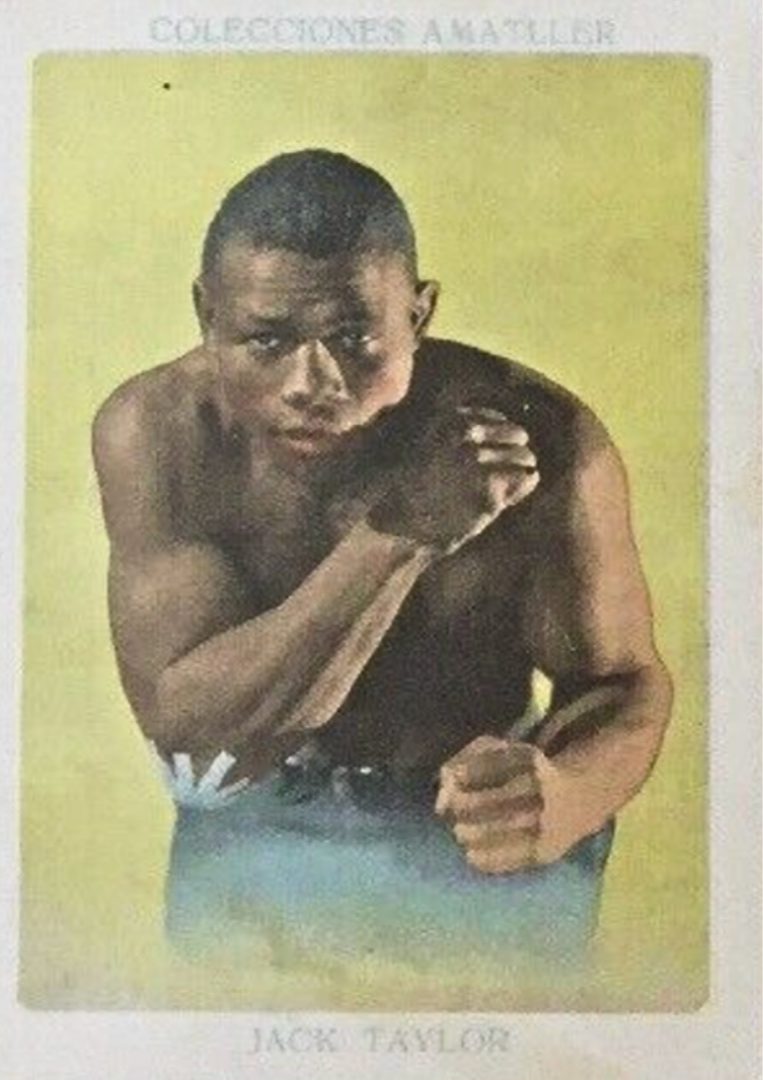
Jack Taylor (one of 33 trading card portraits of boxers), ca. 1928. Published by Chocolate Amatller, Spain. Color lithographic trading card. Collection of the author.
Long before Terence ‘Bud’ Crawford carried Omaha into boxing arenas around the world,¹ the city had already earned a reputation as a fighting town. Its neighborhood gyms produced contenders, its promoters filled local halls, and its spectators followed the sport with an intensity reflected in the crowded pages of Omaha’s newspapers. Fighters came and went, leaving behind nicknames, grainy photographs, and accounts of victories delivered one punch at a time.
Among the most remarkable was Jack Taylor. For a time, his name regularly appeared in the sports pages of newspapers across America. Promoters announced him as the “Nebraska Tornado” and the “Omaha Buzz Saw.” After he battled reigning light-heavyweight champion Kid Norfolk to a draw, they found an even more enticing title for the Omaha fighter: “the One-Half Champion”—a playful, celebratory invitation to come see the man who had fought a world champion to a standstill.² Crowds watched him exchange punches with some of the greatest fighters of his generation. He defeated title-belt holders, crossed oceans, appeared in motion pictures, and remade himself as an athletic trainer and sports therapist. Life carried him from Nebraska to The Hague, and eventually into a Nazi prison camp.
To recover Jack Taylor’s life is to restore more than the legacy of a forgotten boxer. It is to return one of Nebraska’s most extraordinary figures to the historical record while revealing a story shaped by the intertwined histories of race, migration, sport, and war.
The Making of the Nebraska Tornado
Taylor’s start as a pugilist reads like a folktale. According to Taylor, he ran away from home seeking work and found himself in a bar in Seattle. There he was accosted by three men who tried to bully him into leaving. One threw beer in his face. Taylor knocked him out with a right-hand punch in the stomach. The others went out the same way. The next day, “news spread that there was a certain shine, Jack Taylor by name, was licking everybody around.”³
The incident caught the attention of a boxing promoter who took Taylor under his wing and launched a career that would carry him to Nebraska and yonder.
Newspaper headlines soon placed him among the leading boxers of the era. One Omaha paper declared him “one of the best Negro boxers in the game today.”⁴ Another reported that the Omaha boxer had won six fights in twenty-one days. These notices capture the relentless pace of his profession. Six chances in 21 days, for it all to come to an end, or to make him a contender.
A contender he became. While living and training in Omaha, Taylor fought men who held—or would later hold—championship titles. He battled Kid Norfolk and Sam Langford to draws. Langford, one of the greatest fighters never permitted to compete for the heavyweight championship, embodied the limits imposed on Black boxers during the era. Taylor also defeated Battling Siki, Gorilla Jones, and the future German heavyweight champion Max Schmeling. He trained and sparred with prominent fighters, including Jack Dempsey. Dempsey’s trainers said of Taylor, “In addition to being a hard-hitting scrapper, he is also one of the best trainers in the country. Dempsey wants a rugged man to prepare him for future ‘tough customers.’”⁵
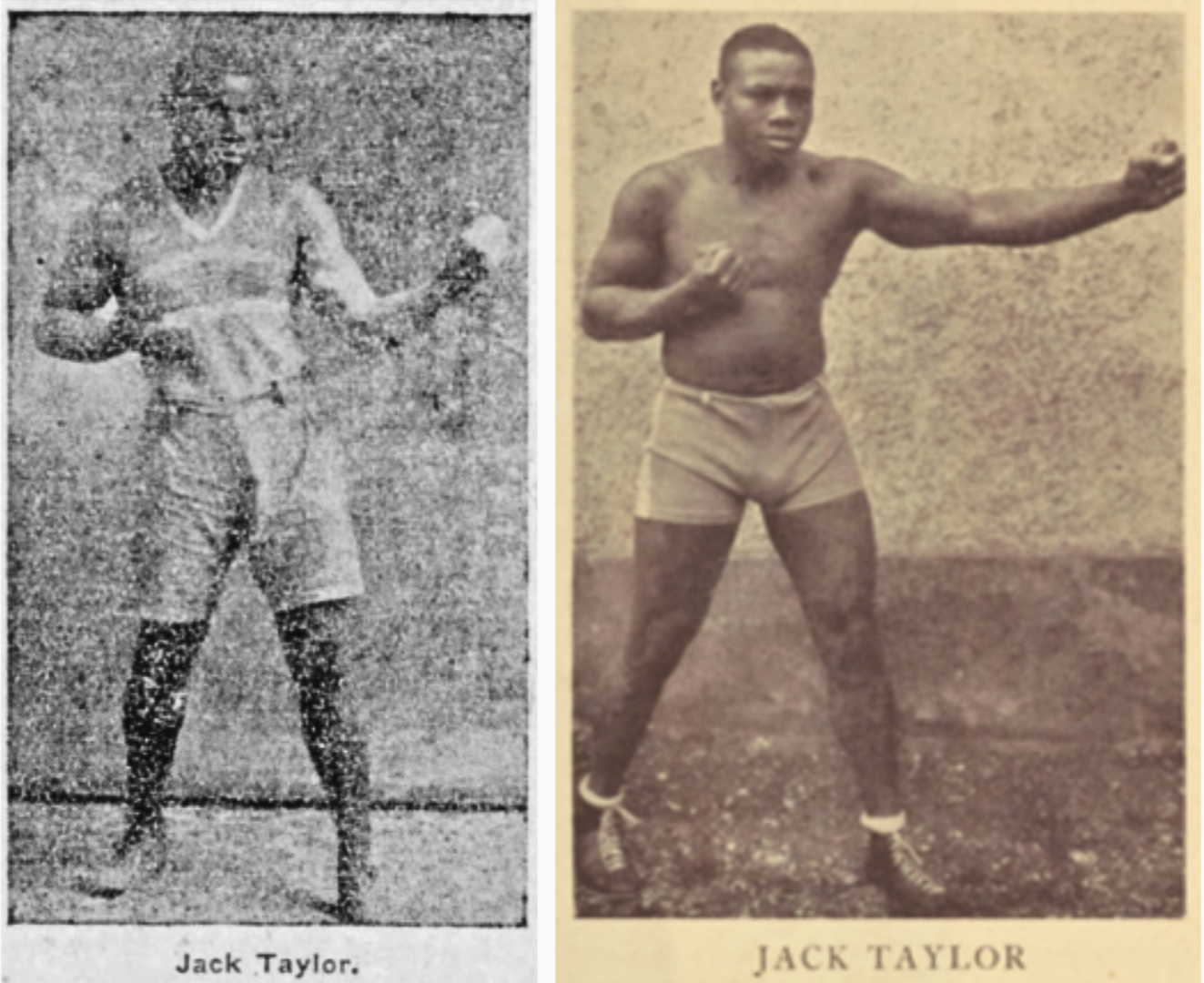
(Left) Jack Taylor in the Omaha World-Herald, Wed, Dec 26, 1923: Page 12. (Right) Jack Taylor: From Negro Anthology, 1931-1934. Edited and published by Nancy Cunard, 1934, page 343.
Crossing Borders
In the spring of 1924, Jack Taylor stood in a Havana prize ring facing Santiago Esparraguera, the reigning Cuban light heavyweight champion. Before the night was over, Taylor had knocked him unconscious and claimed the title for himself. Newspapers in Omaha celebrated the victory. For the city that had christened him the “Nebraska Tornado,” it confirmed what local fight fans already believed: one of the finest boxers in America had come from Omaha’s gyms.

Jack Taylor in the Omaha Daily Bee, Mon, Apr 21, 1924: Page 5.
Though Omaha writers celebrated the Cuban championship as another triumph in Taylor's career, they missed its larger significance. Havana was not simply another stop on an American boxer’s itinerary. Taylor’s decision to compete abroad was made for adventure and opportunity. Boxing in the era of Jim Crow denied many of its greatest practitioners the opportunities their talent deserved. Promoters routinely paid Black fighters less than white opponents with comparable records. Newspapers treated their victories as remarkable exceptions rather than evidence of skill, while white champions often refused to defend their titles against Black contenders—afraid not only of defeat, but of violating the unwritten racial boundary known as the “color line.”⁶
Taylor understood these realities intimately and by the middle of the decade, his career had become truly international. Prize rings carried him across Belgium, Germany, England, Portugal, Switzerland, Scandinavia, and North Africa. The distances themselves remain astonishing. Long before commercial air travel made international movement commonplace, Taylor crossed borders with remarkable frequency, chasing purses wherever promoters assembled crowds eager to witness world-class boxing.
Café Society and Personal Transformation
While prizefighting had introduced him to Europe, it would not define the rest of his life. Training and fighting in Paris exposed Taylor to a cosmopolitan city unlike anything he had experienced in America. During the 1920s, the French capital pulsed with artists, musicians, and writers from across the globe. African American jazz transformed Parisian nightlife. Harlem rhythms echoed through cafés and dance halls. Painters experimented with modernism while writers debated politics in smoke-filled salons.
Taylor entered this world as an athlete, but he proved curious about far more than boxing. He began exploring acting, eventually appearing in two European films: Monte Cristo (1929) and Le Capitaine Jaune (1930).
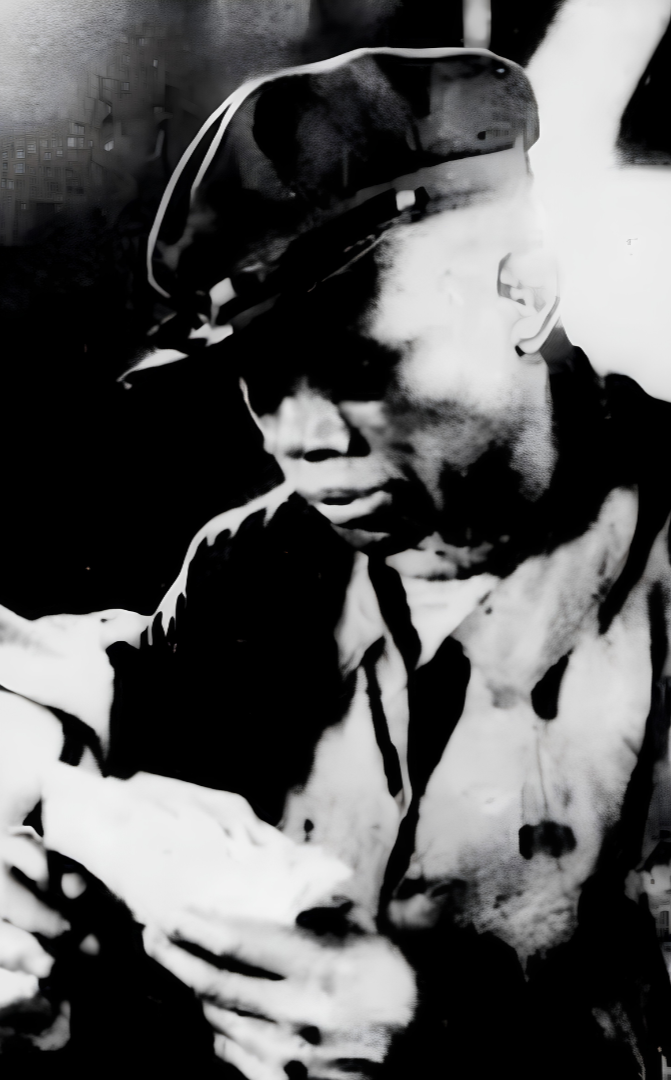
Screen Still of Jack Taylor in the French Movie “Le Capitaine Jaune” (The Yellow Captain), Directed by A.W. Sandberg, 1930.
The surviving records reveal little about how he came to these roles, but their existence alone suggests remarkable adaptability. Boxing careers rarely lasted forever. Taylor seemed determined to reinvent himself before the sport forced retirement upon him.
His transformation continued after he settled in The Hague. There, Taylor established himself as an athletic trainer and practitioner of what would today be recognized as sports therapy. Drawing upon years spent conditioning fighters and recovering from injuries himself, he opened a training clinic devoted to physical culture, massage, and athletic rehabilitation.
Unlike many Black Americans confined to the narrow occupational categories available under Jim Crow, Taylor became his own employer. His reputation—not merely his fists—generated income. The boxing ring had opened the door, but knowledge kept it open. For perhaps the first time in his life, he possessed the ability to determine both his work and his future.
Friends remembered him as prosperous. He dressed well. He moved comfortably through European society. He developed professional relationships that extended well beyond boxing.
Europe had become home.
Arrest and Internment
As the scourge of Nazism spread across Europe, borders that had once enabled artistic exchange hardened into military frontiers. Nations fell with alarming speed: Austria was absorbed into the Third Reich, Czechoslovakia was dismantled, and Poland collapsed beneath invasions from Germany and the Soviet Union. In May 1940, German forces swept into the Netherlands. For Taylor, The Hague—the city where he had found refuge from Jim Crow—became the setting for a second confrontation with a society organized around racial hierarchy.
Once the United States entered the war in December 1941, German authorities arrested Taylor and transported him east into the Bavarian town of Tittmoning, where a medieval fortress overlooking the Salzach River had been transformed into an internment camp for foreign civilians.
With Taylor were dozens of Black Americans whose stories have remained largely absent from conventional histories of the war. Some of these include jazz pianist Freddy Johnson, dancer Evelyn Anderson, musician Henry Crowder, and wrestler Reginald Siki.⁷
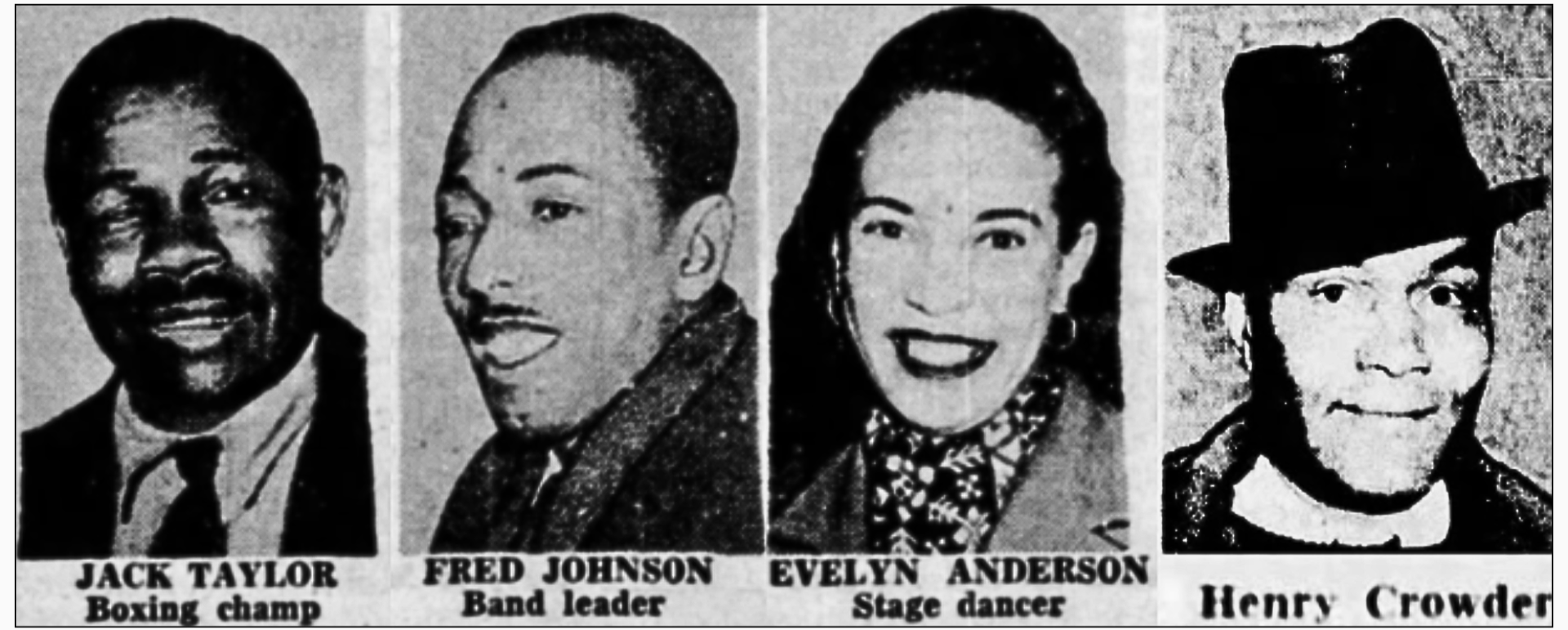
A grouping of Black American athletes, musicians, and culture-workers imprisoned by the Nazis.⁸
These Americans shared confinement with individuals from around the globe. Some had lived in Europe for decades. Others had arrived only recently. Businessmen, artists, musicians, teachers, engineers, missionaries, and athletes suddenly found themselves living together because their nationalities had become military assets. They were hostages of diplomacy, intended for eventual exchange with German civilians interned by the Allies.
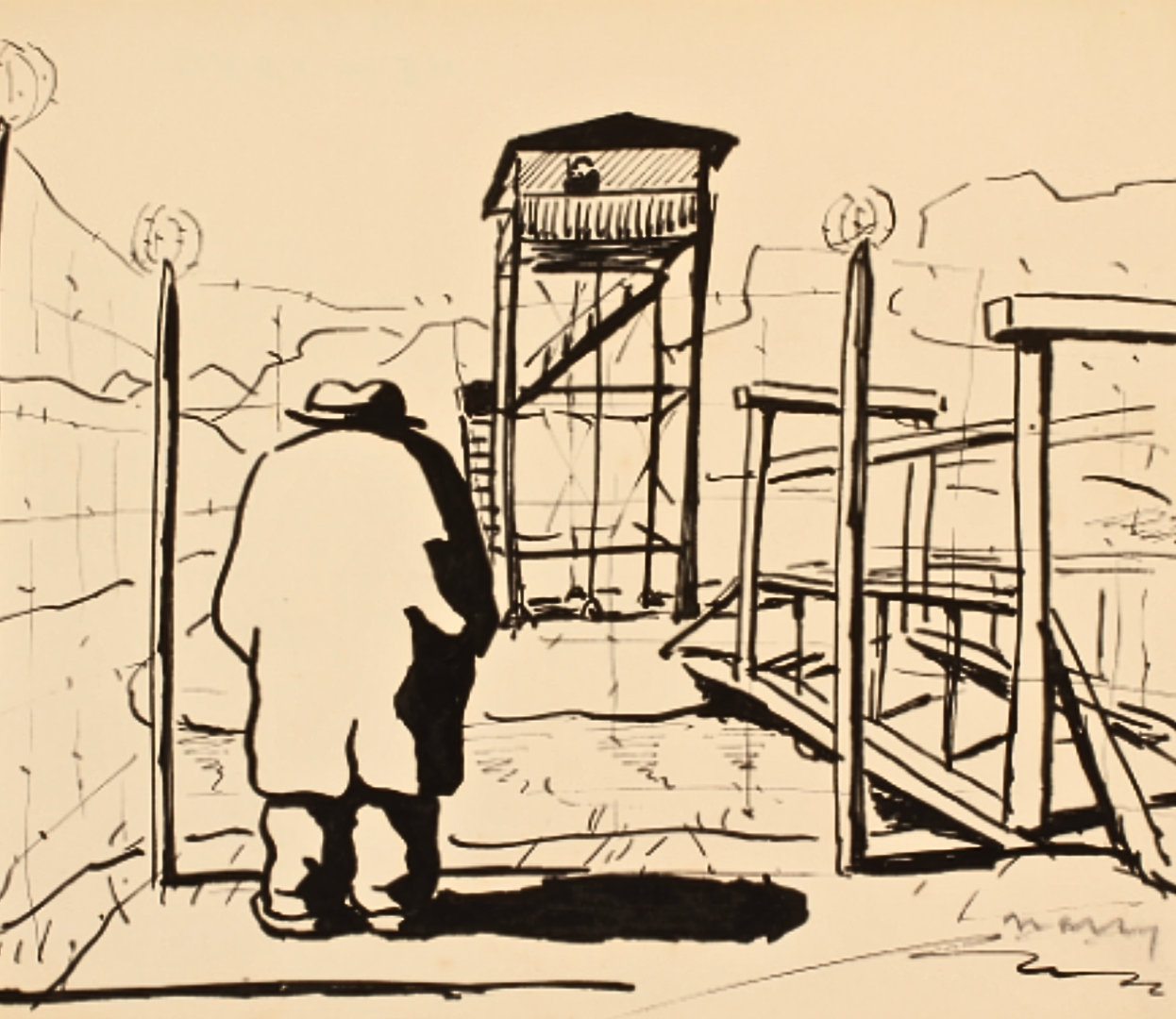
Drawing by Josef Nassy created while interned at Civilian Internment Camp Ilag VII (Laufen/Tittmoning), Germany, ca. 1942–1945. Accession Number: 1991.245.138, Josef Nassy Collection, United States Holocaust Memorial Museum Archives, Washington, DC. Nassy’s artwork documents the exact environment shared by African American boxer Jack Taylor and other Black expatriate internees. Used for non-commercial, educational historical commentary under Fair Use.
Though Tittmoning differed from the Nazi extermination camps, it was nonetheless a place of suffering and uncertainty. Prisoners faced constant surveillance, restricted movement, and the ever-present fear that conditions might worsen.
One of Taylor’s Tittmoning companions was Josef Nassy, an artist of Surinamese and Jewish ancestry whose remarkable drawings and paintings would later become one of the most important visual records of civilian internment under the Nazis.⁹ Supplied with brushes through the International Red Cross and YMCA, Nassy transformed imprisonment into art. His work depicts guard towers, barbed wire, bleak corridors, and weary prisoners moving through enclosed spaces stripped of color and hope. Taylor and Nassy walked these same yards.
Another of Taylor’s fellow internees was Max Brandel, a Polish Jewish artist who captured Taylor through caricature. After the war, Max moved to New York and made his living as a cartoonist for various publications, including Mad Magazine.
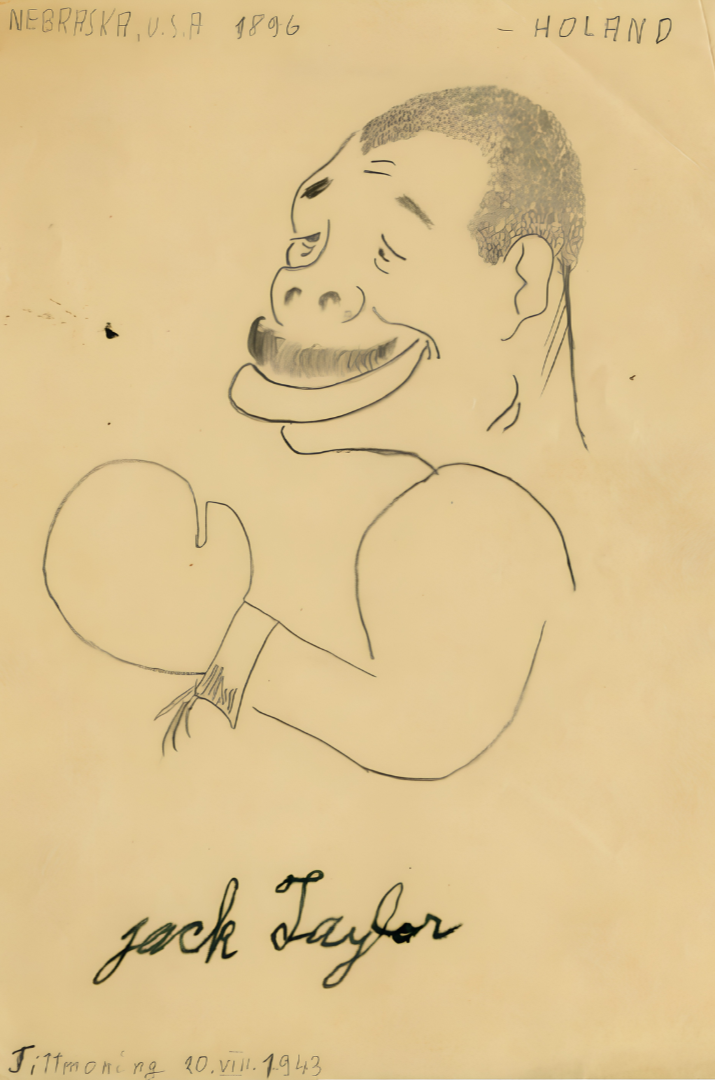
Max Brandel, Caricature of Jack Taylor, ca. 1940s, Collection of the Jewish Heritage Museum.
Max’s drawing above shows the boxer smiling broadly, his gloved fists exaggerated almost to comic proportions. It was intended as a gift for Jerome “Jerry” Mahrer, the youngest prisoner in the camp. Even within confinement, Brandel found reason to make another prisoner laugh.
Taylor was remembered as someone whose presence inspired affection, and he became known for his generosity and kindness. Long before massage therapy became widely accepted within sports medicine, he had developed expertise treating athletic injuries through physical manipulation. Those skills accompanied him into captivity. Fellow prisoners recalled Taylor offering therapeutic massages that eased aching muscles, relieved stress, and provided moments of physical comfort inside an environment almost entirely devoid of it.
One of the last pieces of existing visual ephemera capturing Taylor before his release is a Red Cross image taken in 1943.
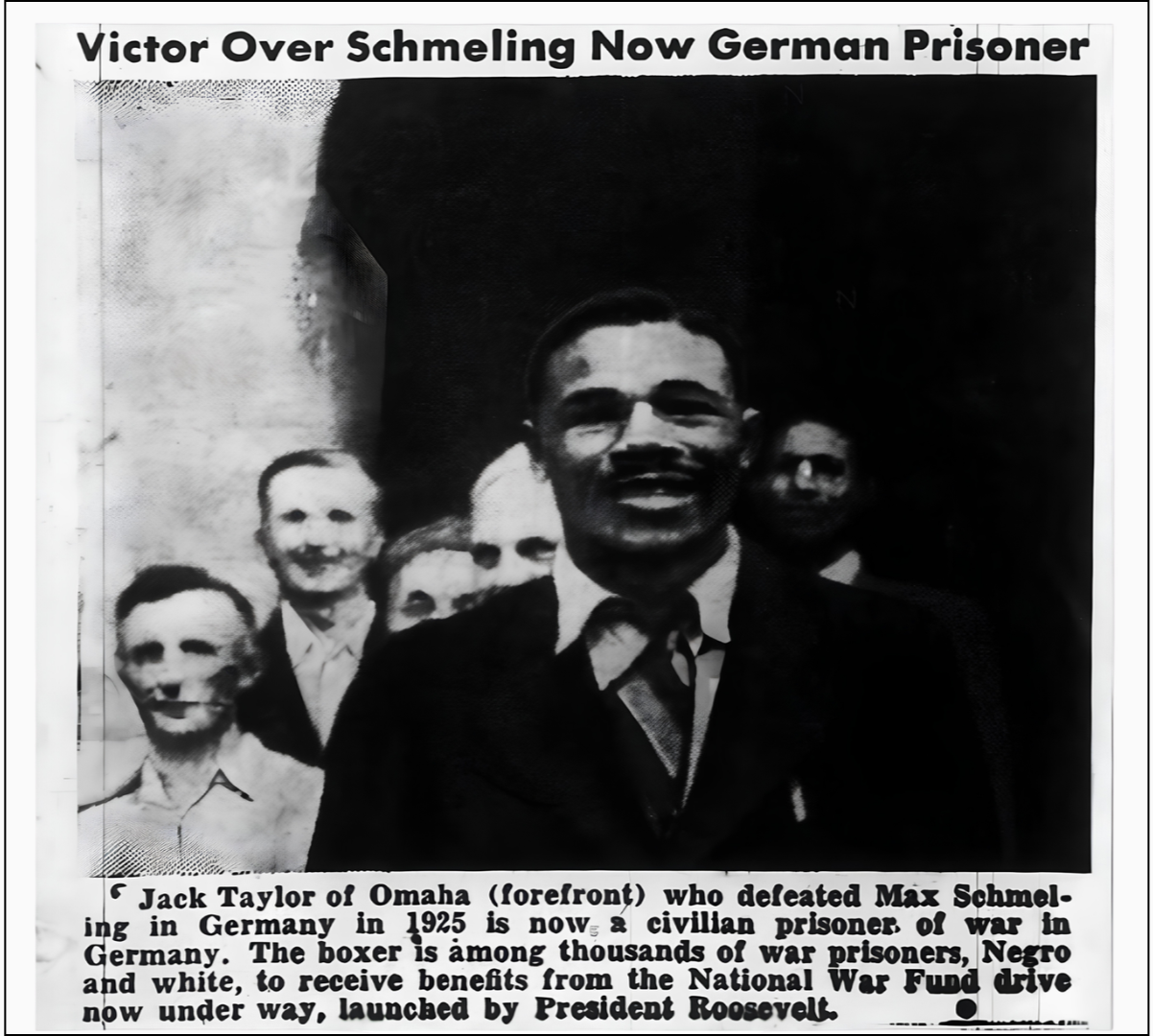
Jack Taylor in the Omaha Star, Fri, Oct 22, 1943: Page 1.
In the photo, Taylor stands confidently before his fellow prisoners. He is smiling, seemingly addressing an audience rather than fellow detainees. The newspaper caption focuses on his boxing history: “Victor Over Schmeling Now German Prisoner.” Before the rise of the Third Reich, Taylor had defeated the German boxer who would later become one of their nation’s greatest sporting heroes. Now Taylor himself was imprisoned inside Germany.
History has a way of arranging such cruel symmetries.
Repatriation
In early 1944, a prisoner exchange had been negotiated. The Nebraska Tornado was leaving Germany.
He would never truly recover what had been taken from him.
On March 16, 1944, Taylor boarded the M.S. Gripsholm, a converted Swedish ocean liner. Painted white with broad red crosses along its hull, the Gripsholm sailed under neutral protection, carrying civilians exchanged between the Axis and Allied powers. It transported diplomats, missionaries, families separated by war, and prisoners whose governments had negotiated their release. While battles raged across Europe and the Pacific, the ship occupied a narrow humanitarian corridor between worlds at war.
For Taylor, boarding the Gripsholm marked the end of more than two years of captivity.
The archival record catches Taylor only briefly upon his return to the United States. Just days after disembarking, he registered for the Second World War draft. The document is striking in its simplicity. Bureaucratic forms rarely reveal emotion; they record only facts considered useful to the state. Yet within a handful of lines lies the outline of an entire tragedy. His address was a YMCA in Harlem. His occupation no longer reflected the prosperous athletic clinic he had once operated in The Hague.¹⁰ And under physical characteristics appeared a devastating notation: “Sight of right eye lost.”
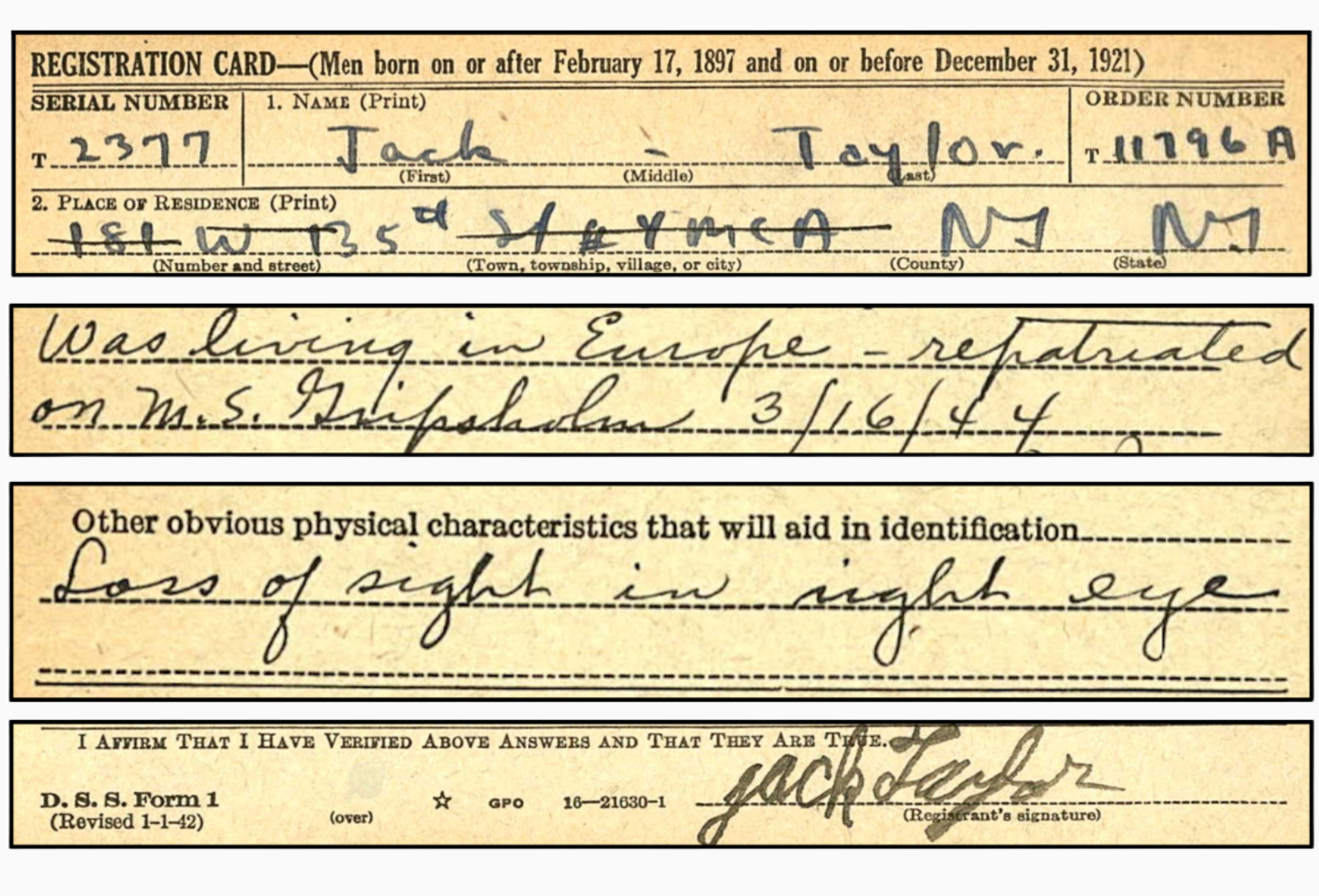
From Jack Taylor’s WWII Draft Registration Card: “Jack Taylor was living in Europe. Repatriated on M.S. Gripsholm, 3/16/44.”
The document invites more questions than it answers. How had he lost his vision? Was it accumulated punishment from decades inside the boxing ring? Was it an injury sustained before the war, or during internment? Did inadequate medical care worsen an existing condition? The archives remain silent.
One might have expected Taylor to remain in America after the war. Yet although the prisoner exchange returned him to the United States, it did not return him home. The United States remained a segregated nation. Lynching had not disappeared. Jim Crow remained law across much of the South. Housing discrimination, employment discrimination, and racial violence persisted throughout the country.
Taylor had spent decades living beyond those constraints. Europe—even devastated by war—may still have represented the place where he most fully understood himself. Before long, Taylor made his way back to Europe.
The life awaiting him there, however, bore little resemblance to the one he had lost. Prosperity earned through years of brutal labor inside prize rings and careful work as a sports therapist had evaporated during internment. Like countless individuals imprisoned by the Nazi regime, Taylor emerged free but economically ruined. Years that might have been spent building security had instead been consumed by confinement.
The archives become increasingly sparse during these final decades. Records indicate that Taylor lived intermittently with friends and in boarding houses around The Hague. There are no newspaper headlines celebrating his return. No testimonials honoring his remarkable survival. No public campaign to restore the fortune taken from him. One of the most accomplished athletes Nebraska had ever claimed quietly slipped from public memory.
The final chapter of his life borders on heartbreak. Taylor was offered a small room in the lodgings of a brothel. The women who lived and worked there cared for him during his final years—women whose own lives frequently existed on society's margins became the ones who ensured that an aging boxer would not die entirely alone.
Jack Taylor died on January 20, 1963. He was buried in Nieuw Eykenduinen Cemetery in The Hague. No Nebraska newspaper appears to have been aware of, acknowledged, or remembered that the “Nebraska Tornado” had died an ocean away. History, it seemed, had forgotten him.
Coda
Recovering Jack Taylor’s life required assembling hundreds of fragments of his life’s story—and though this bricolage fails to provide a complete picture of his life, it nonetheless reveals an extraordinary story.
Taylor’s life story reshapes how we understand Nebraska. Too often, state history is written as though it unfolded within state lines. Nebraska appears isolated, its people rooted to farms, towns, and prairies. Taylor reminds us that Nebraskans participated in profound international histories. The “Nebraska Tornado” fought across multiple continents, defeated future world champions, acted in European cinema, survived Nazi imprisonment, and died in the Netherlands. His life connected Omaha to Havana, Paris, Berlin, and The Hague in ways that conventional state histories rarely acknowledge.
His story also broadens African American history.
Further, while historians understandably emphasize the struggle for civil rights within the United States, Taylor’s story reminds us that Black history has always been global. Taylor was not fleeing America so much as pursuing possibilities it refused to offer.
Throughout the twentieth century, African Americans crossed oceans seeking educational opportunities, artistic freedom, economic independence, and lives less constrained by American racism. Their experiences formed a diaspora that stretched across Europe, Africa, Latin America, and beyond.
Finally, Taylor’s life expands our understanding of the Second World War itself. When Americans remember Nazi camps, they rightly think first of the Holocaust and the millions systematically murdered by the Nazi regime. That history must always remain central. Yet alongside those crimes existed other forms of persecution, imprisonment, and displacement that complicate our understanding of wartime Europe. Black American civilians, confined because their nationality rendered them bargaining chips in international diplomacy, occupy one of those overlooked histories. Their experiences remind us that fascism's reach extended into lives rarely discussed in either military, African American, or even our own state history.
End Notes
1. Morale III, Amos and Sarah Shepard. 2025. “Pound-for-pound great Terence ‘Bud’ Crawford retires from boxing at 42-0." The Athletic at the New York Times. Dec 16.
2. Boxing nicknames are a staple of the sport, giving fighters an intimidating persona, reflecting their fighting style or place of origin, and providing promoters with a memorable way to attract a crowd. Jack Taylor adopted—or was assigned by promoters—several such names during his career. After moving to Omaha to train and fight, he became known as the “Nebraska Tornado,” a reference to both his new home and his whirling punching style. He was later advertised as the “Omaha Buzz Saw.” Following his ten-round draw with reigning light-heavyweight champion Kid Norfolk in 1922, newspapers and promoters playfully celebrated Taylor as the “One-Half Champion.” The phrase was not an officially recognized boxing title but a piece of promotional arithmetic: if Taylor had fought the champion to an even draw, then Omaha could claim at least half a champion of its own. See: Omaha World-Herald, “Kid Norfolk vs. Jack Taylor,” June 20, 1922, 12; Omaha Daily News, “Arithmetic and Fighting,” October 11, 1922, 11; and Pittsburgh Post, “Norfolk Beats Taylor,” March 28, 1923, 12.
3. Cunard, Nancy (ed). Negro: Anthology. 1934. Page 343.
4. Omaha Daily Bee. 1924. “Omaha Battler One of Best Negro Boxers in Game Today.” Sun Jan 20, Page 11.
5. The Omaha Daily News. 1922. “Omaha Boxer Asked to Help Train Dempsey for fight.” Thu Aug 3. Page 10.
6. Benson, Peter. 2006. Battling Siki. The University of Arkansas Press.
7. Those pictured or mentioned with Jack Taylor include:
Jazz Musician Freddy Johnson. Johnson began playing professionally in the early 1920s as the accompanist to Florence Mills. He led his own band in 1924 and worked with Elmer Snowden the following year. He also had stints with Billy Fowler, Henri Saparo and Noble Sissle, and made his recording debut with trombonist Te Roy Williams in 1927.As a member of the Sam Wooding Orchestra, Johnson traveled to Europe in 1928, made quite a few recordings with the band during 1928-29, and then stayed in Paris as a soloist and co-leader of a band with trumpeter Arthur Briggs. In 1941, soon after the attack on Pearl Harbor, Freddy Johnson was arrested in the Netherlands by Nazi officials. Freddy was first sent to Amersfoort and was later interned in Tittmoning. He was held there from January 1942 until February 1944. About a year after his arrest, his wife (Ida Mack) and daughters (Jacqueline and Marilyn) were rounded up and sent to Amersfoort and then interned in Liebenau, another camp for foreign nationals.
Jazz Dancer, Evelyn Anderson, who was interred in Liebenau with Freddy Johnson’s wife and daughters. Evelyn Anderson arrived in Europe in 1925 as a member of the Black Birds troupe that danced with Josephine Baker. Evelyn was arrested in 1942 and designated an “enemy alien” by officials in Nazi-occupied Holland where she was appearing in a cabaret. Evelyn was eventually released in March 1944 with twelve male African American POWs as part of a prisoner exchange for Allied-held German inmates.
Henry Crowder was an American jazz musician who lived as an expat in Paris. Although Crowder returned to the United States several times before World War II, he always chose to return to Europe. As he wrote in 1934, “In Europe the Negro will learn that color prejudice, though it exists in some places…is never, as in America, a religion or a creed.” After the Nazis invaded France, he was interned for 22 and a half months in several internment camps, first in the camp Beverloo in Belgium then in Tittmoning Germany. Born in Gainesville, Georgia, Crowder was a largely self-taught jazz pianist. He began his career playing the piano in brothels and other such establishments in Washington D.C. He became a bandleader before departing for Europe (1928). He met shipping heiress Nancy Cunard in Venice when he had a residency at the Hotel Luna, and both later became involved romantically and professionally. Cunard’s famed anthology Negro was inspired by Crowder. He was released in a prisoner exchange in March 1944. Following his death in 1955, the Atlanta Daily World reported that Crowder returned from internment "broken in health" and had told a friend that "his music was all that held his sanity together."
Reginald Berry was one of the first African American professional wrestlers. Born in Kansas City Missouri in 1899, he often claimed a colorful but completely invented past (per the performance art often practiced in professional wrestling), stating that he was born in Senegal or, more often, Abyssinia (also known as Ethiopia). Berry did however note that both of his parents had Ethiopian ancestry. Little is known about his youth, but newspaper articles suggest that Berry was a California state wrestling champion (possibly the winner of a YMCA tournament) and wrested collegiately for a short time at the Ohio State University (The Daily Times 1931 July 14:15). In the 1923 he turned professional and was well known throughout the United States, wrestling under many names including: “Reginald Siki,” or “Regis Siki” (inspired by the famous boxing champion and showman of the 1920s known as “Battling Siki”). Berry also went by the name of the “Abyssinian Lion” and the “Abyssinian Panther.”
8. Sources: The Afro-American. 1944. “Each of Them Had a Story About Nazi Prison Camps” Sat March 25. Page 1., New Journal and Guide 1944 “Freed from Nazi Prisons” Sat March 24. Page 1.
9. Rothschild-Boros, Monica C. 1989. In The Shadow of The Tower: The Works of Josef Nassy 1942-1945. Severin Wundermann Museum.
10. Kramer, Robbert. 2025. “The Untold Story of Jack Taylor.” Medium.
John Paul (he/him) is an arts administrator, curator, and interdisciplinary artist based in Omaha, Nebraska. He serves as Director of Programs and Exhibitions at Clover24, where he develops exhibitions, public programs, and community partnerships that support artists and expand access to the arts.