
Hermit Jim and the Massive Fire
by Patrick Mainelli
June 29, 2026
“Turning away and touching are both wrong, for it is like a massive fire” – Dongshan Liangjie
“Are you guys ready for a real economic crash?” someone I will never meet asked me while I was in bed the other night. “None of you are ready to live in absolute poverty,” he said. “No more jobs, no more electricity, and no more internet; instead, a civil war will be triggered. Do not travel this summer. A lot of looters will be active.”
“Cool,” I thought and added it to my inventory of one trillion other aimless claims that the machine mind of an algorithm has calculated would be most intoxicating to a consumer like me. And then I fell asleep. Possessed by strangers, dreaming my way through a subconscious swamp of half-sincere desires, unmoored impulses, lust, and commerce, and fear, fear, fear.
This spring, I sat with my neighbor Catherine in her living room. We’d met in the garden years ago. She had crossed the street for a closer look at the liatris I’d planted, blooming and covered in monarchs that August. I offered to dig some up and plant them at her apartment. I’d see her in the summer when she was out walking and we’d talk plants, but until this spring visit, our relationship had been purely botanical. Now I came to her with questions.
Catherine’s a Sister of Mercy. Though she’s retired from the official duties of her order, she still leads a life of service. This includes her volunteer position as historian and archivist at Fontenelle Forest. She’s been at this work for several years, combing through the deep histories of human relations with the land: the Fontenelle Trading Post of the 1820s, the “Nebraska Phase” peoples of centuries before, the Mormon migration. All rich stories to tell. All subjects I could have spent a full day unpacking with Catherine. But I needed to ask her about the hermit.
“If there’s anyone who can talk about Jim Baldwin, it’s probably me,” she told me with a small laugh when I first called her on the phone and asked if we could meet. I knew only the bare details, myself. They’d been reported in the Omaha World-Herald a few different ways over the years. From about 1920 until the early 60s, this guy, Jim Baldwin, lived in the oak savannah bluffs above the Missouri floodplain, adjacent to the land managed by Fontenelle. After coming home from the infantry of World War I, he retreated to the woods and pretty much never left. In that time, the country outside his hermitage would fall into the Great Depression, invent jazz, fight the Nazis, split the atom, buy televisions, and elect seven presidents. Jim Baldwin planted a garden, swam in the river, and studied the seasons. As a hermit, his commitment to solitude made Henry Thoreau’s sojourn at Walden Pond look like a glamping getaway.
Through Catherine’s window, an assembly of birds, house sparrows and nuthatches, swarmed her feeders. “I wonder if those birds just go back and forth across the street from your feeders to ours,” I asked her.
“I’m sure of it!” she said with some delight. “They’ve probably memorized every feeder in the neighborhood.”
There are a few remaining photos of Baldwin, taken by curious hikers who encountered him in the woods. In nearly all of them, you see a person living in absolute poverty. Usually with no shirt or shoes. A belt made out of rope. His home and possessions amounting to not much more than a collection of sheet metal and broken boards.
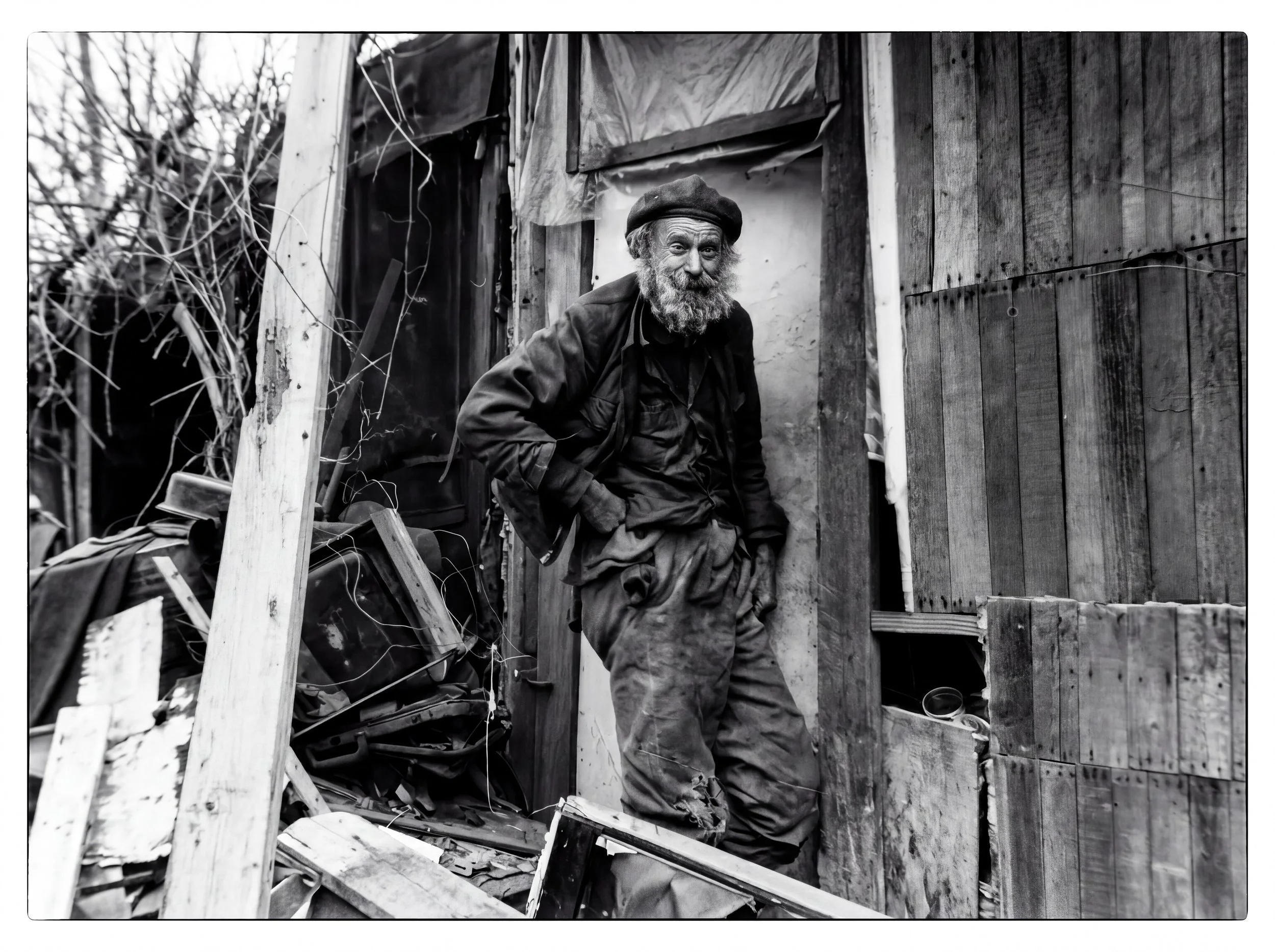
“I don’t think you could really even call his house a building!” Catherine told me. Some reports said that in the heat of the summer his home was nothing but a dirt cave, or a hammock stretched between two trees. Catherine showed me a paragraph written by former Fontenelle Director Jim Malkowski, describing Baldwin’s setup: “It wasn’t much more than a couple of beams holding up a few boards. You had to crawl through an entry into a small room with a dirt floor. He had gathered books and magazines of all kinds, and after he read them, he packed them against the walls. It reminded me of a mouse’s nest.”
“You look at these old pictures,” Catherine said, “and it seems, honest to God, this is a man who really gave himself over to nature.” There is one photo in particular she shows me that’s especially striking. Bare-chested, he looks as strong as a tree, with arms bigger than my whole torso, and whimsical as a gnome with his long beard tied up in a cute braid. In so many images he is squatted on the ground, obscured by plants, looking both serene and totally wild. Given over.
For years, I’ve carried a small obsession with this man in the woods, making trips to the site of his home, sitting for hours under the trees where he once sat, conjuring ideas about the widest possible meaning of freedom.
Of course, it’s not so rare to live like Jim Bladwin lived. In the sweep of human experience, more people have lived this way – eking out a marginal existence on some small piece of land, farming a little, hunting a little, cold and hot, calloused and dehydrated – than have lived any other way. People still live this way all over the world. But in the 1950s, to be living alone, bearded and dirty in the woods, just a few miles outside a Middle American city of a quarter million reasonable people, was to have made an extreme choice.
And this choice, this radical way of being, was my obsession. What would it be like to live so deliberately? To be still. Not wrung out by the constant, impotent grasping at “something else” that seemed to be the default way of living these days.
I showed Catherine a photo on my phone that I’d taken years ago. Somewhere in the area of Jim’s homesite, deep in the understory, I found what looked like a rusted typewriter. A cool artifact that thrilled me when I found it, mainly because it suggested that Baldwin had been a writer. Had he left some record, some way that I might know his mind more intimately?
“Do you know if there’s any writing of Jim’s that’s still around?” I asked her.
She shook her head. “Nothing we know of.”
I’m just one in a long lineage of people who’ve been infatuated with Jim Baldwin. The forests outside Bellevue, Nebraska are not so deep a wilderness that a person could really disappear completely in them. People knew there was a man in the woods. During his life, he was actually kind of a living urban legend. Boy Scouts from Camp Wakonda nearby were always eager to get a glimpse. A 1951 advertisement for a middle-school Winter Camp even lists “a visit to Jim Baldwin’s” as a featured activity. Nearly everyone who encountered Jim described him in a similar way: Enthusiastic and kind. Happy to have been found. Eager to share stories of life in the woods.
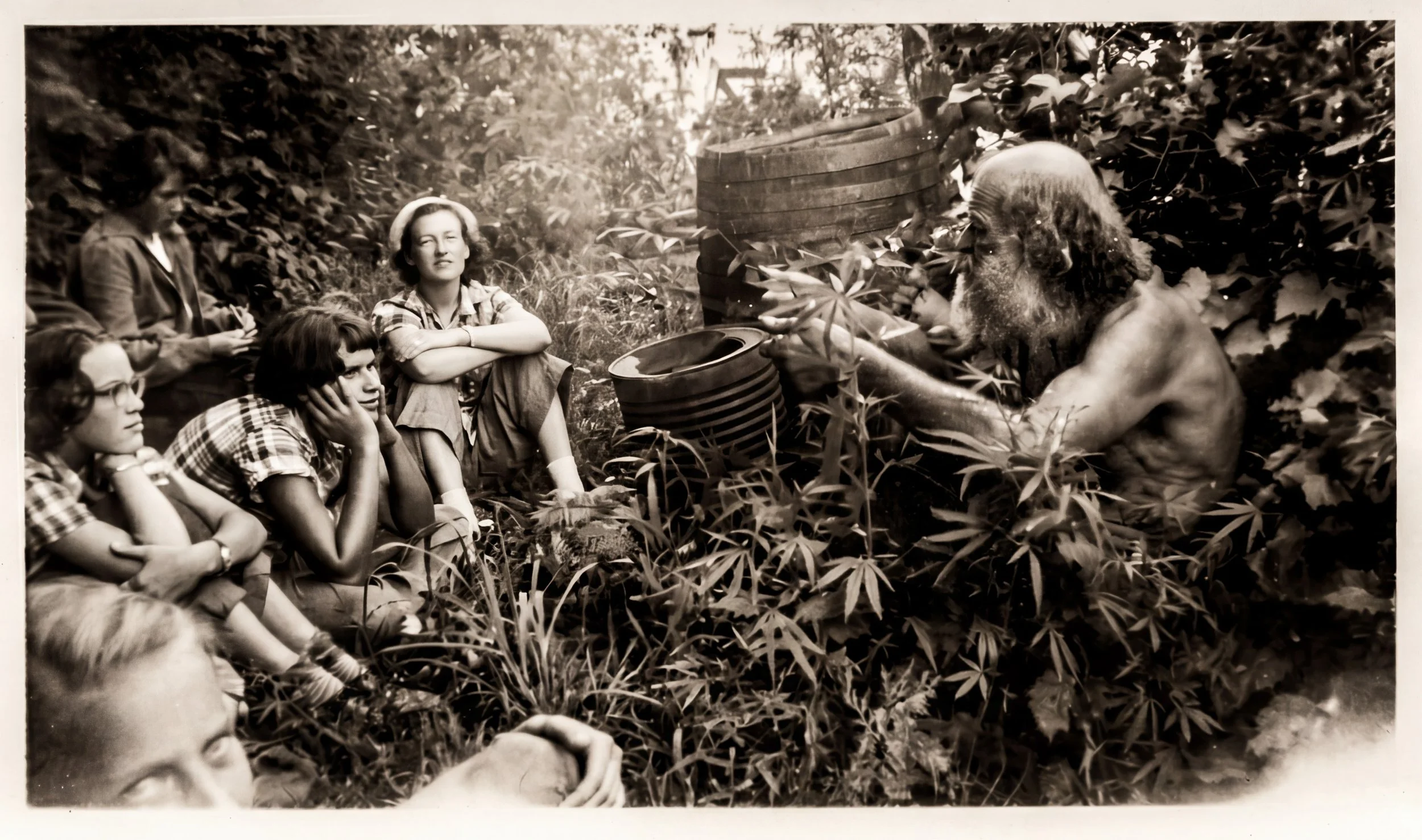
In 1954, an Omaha World-Herald reporter traveled into the trees to get the hermit on record. Baldwin said that what little money he needed he earned from selling produce from his garden. His $65 annual property tax was his most burdensome regular transaction. Pressed on why a man would live alone out there in the elements, Jim asserted: “You say you think it’s odd for a man like me to leave what you call civilization to live in the woods? Well, now, I just don’t know about that. You were busy killing each other when I pulled out of the mess after World War I, and it don’t seem to me you been doin’ much of anything else since.”
I asked Catherine what she thought living so long alone in the woods would do to a person. Taking a pause, she said: “You can’t force nature. Nature is. We’re not alone, and if everyone uses their fair share, we have enough of everything. Living that close to the earth, in that state of dependency for so long . . . I think the only natural outcome is joy.”
In 1959, the World-Herald ran another story on Baldwin. “Hermit Finds Peace Illusion” was the foreboding headline. One afternoon in June, two 17-year-old boys had come to find him. As many kids had before them, they asked Jim to entertain them with stories of the forest. While Jim indulged them, bent over to show them how to make a campfire, they hit the 69-year-old man in the back of the head with a lead-weighted pool cue. Gruesomely, after a few more blows to the temple, Jim’s right eye popped out of its socket.
The kids ran. Jim crawled nearly two miles out of the woods with his soiled eyeball stashed in his pocket. Someone called an ambulance, and for the next several weeks, he recuperated at Veterans Hospital. The whole drama lit up a small media sensation. Could the doctors save the eye? Wouldn’t his garden go to weeds while he was away? Who would do such a thing? “The attack upon Old Hermit Jim Baldwin,” wrote the Editor of the Bellevue Press, “just about broke my faith in the future.”
How surreal those weeks in the hospital must have been. Surrounded by machines, air conditioning, shut in behind closed windows, eating sterile hospital food. Still, reports were that Jim was a cheery patient, “singing a gory song” even moments after the attack, as the ambulance had driven him away. “When nurses began to wash him for emergency surgery, Old Jim complained jokingly that it wasn't time for his annual bath.” There are photos of him there in the hospital. White patch over his eye, looking strangely naked with a fresh shave, Jim is laughing and surrounded by kids who’d come to visit him.
When he was finally well enough to go home, a full spectacle was planned. A limousine escorted Jim back to the edge of the woods where he was met by the mayor of Bellevue, the Offutt Air Force band, and hundreds of young kids, happy to see their hermit home. Asked about his feelings toward the attackers, Jim was beatific: “I’m not mad at anybody and never have been.” Though they tried, the doctors weren’t able to save the eye. Regarding his new glass replacement: "Oh, it'll come in handy," he said. "I'll put in a blue marble when I'm happy and a red marble when I'm mad."
For nearly an hour, Jim goofed around and sang with his young well-wishers before an Air Force helicopter brought him back home to silence.
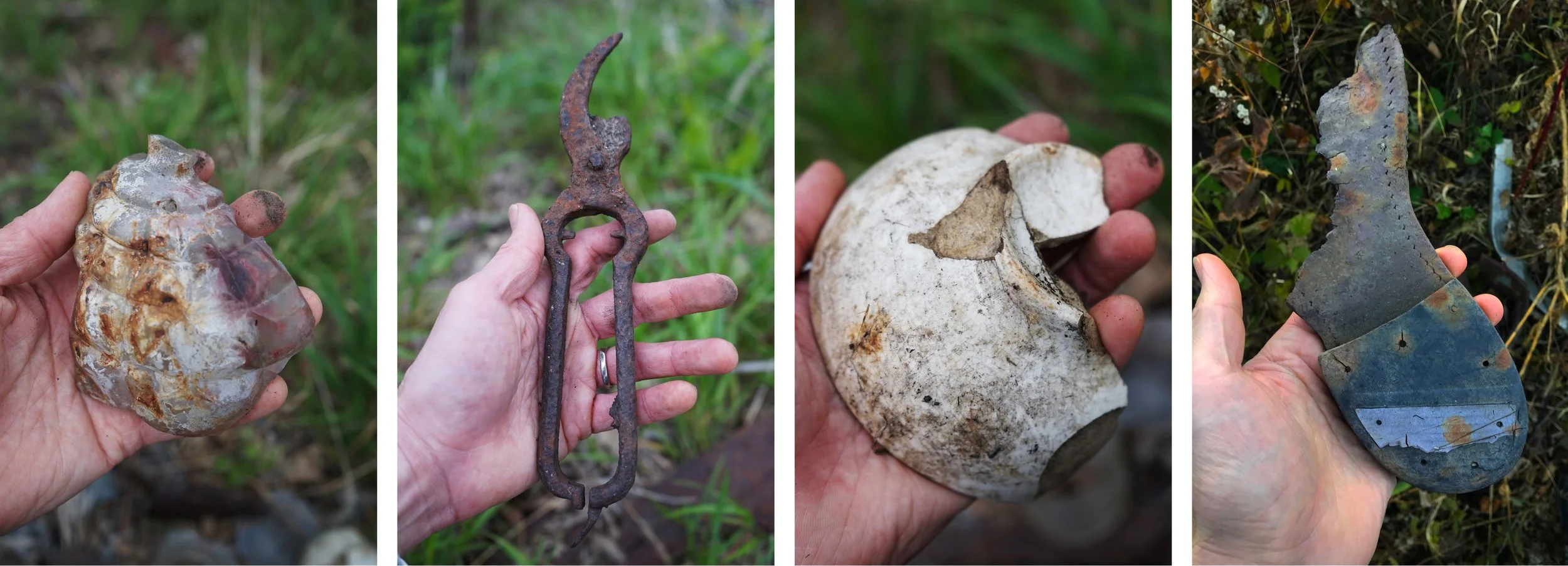
It’s been almost 60 years now since Baldwin left the woods. If you walk the two miles into the trees, you’ll still find some evidence of his life there, rusting in the nettles. His little twin bed is there. The skeleton of a wagon. Some hand tools. Ceramic and glass and aluminum. When I’m there, sifting through what’s left of it all, I have this strange sense of touching something that feels very, very old. Artifacts of something that is nearly extinct.
After the attack, Jim lived a few more years in the forest but was never back to full strength. There was another stay in the hospital in the winter of ‘61 after he was found badly frostbitten and nearly hypothermic. A few months later, he moved in with his sister on Martha Street. He died in town.
“To me, only the seasons mean anything,” he told the paper back in 1954. I’d like to imagine this kind of devotion is still possible. I’d like to imagine it’s possible while also answering emails and paying the mortgage on time. But this is up to me. There is no such thing as running away.
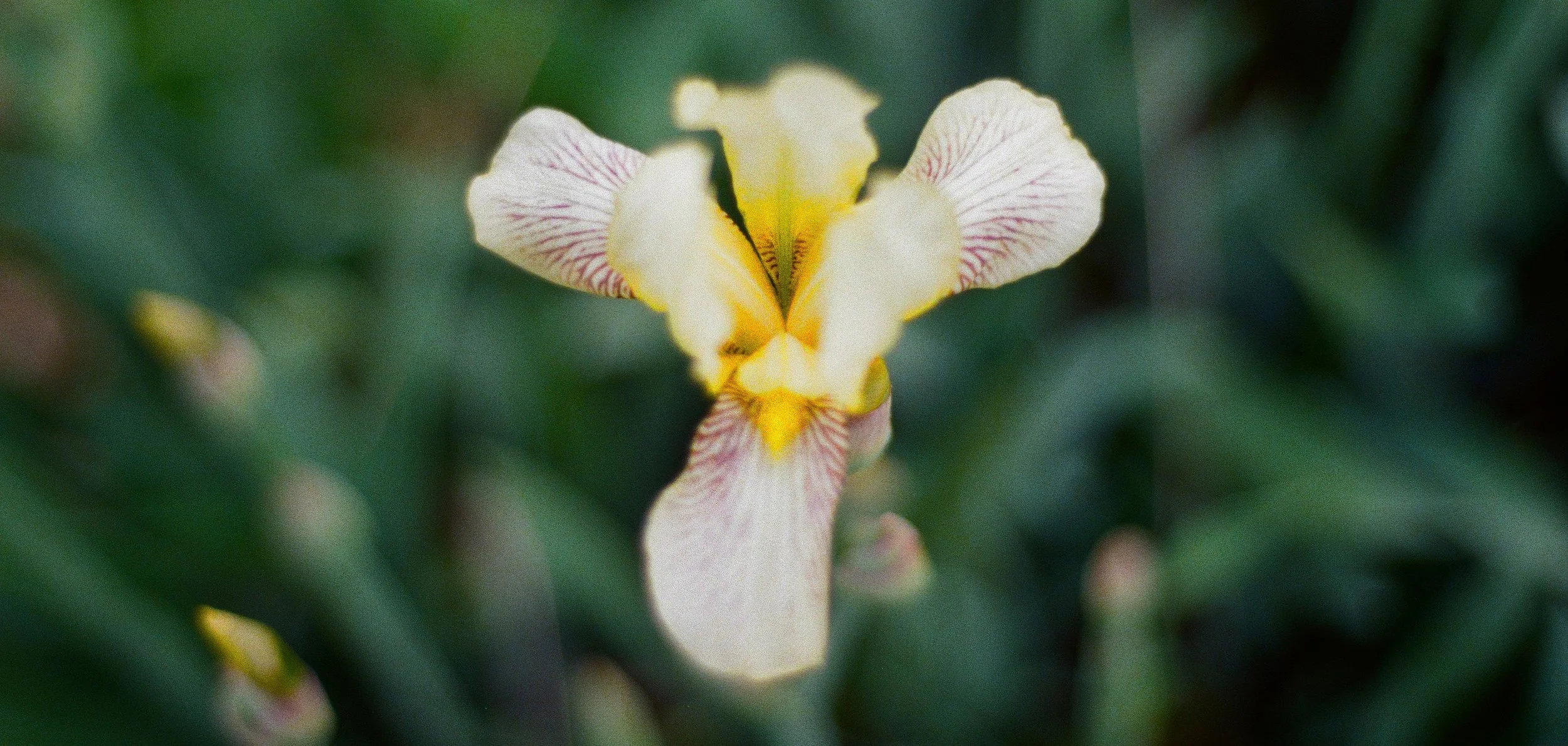
While most of the evidence of Jim Baldwin’s life has been absorbed back into the woods, there’s one remnant that’s only grown with time. For about two weeks every May, if you care to look for them, you’ll find hundreds of yellow irises blooming at the edge of the bluff. Jim planted them. They are an anomaly, foreign to the world around them. And still they thrive, doubling and tripling in abundance over the decades. But unlike the many other invasive species that blight the forest, their impact is gentle, staying only where they’re planted. Just rooting deeper and deeper in one place through these many years. It’s a quiet presence, though. Even their flowers, small and butter yellow, seem content to remain unseen.
Acknowledgements
Thank you to Catherine Kuper for her insight and research; to Tyler Irvine and the staff of Fontenelle Forest for support of this project and access to their archives; to Harrison Martin for still teaching me how to edit photos; and to Noah Sterba for waking up at an ungodly hour to capture the sound of Jim’s dawn chorus.
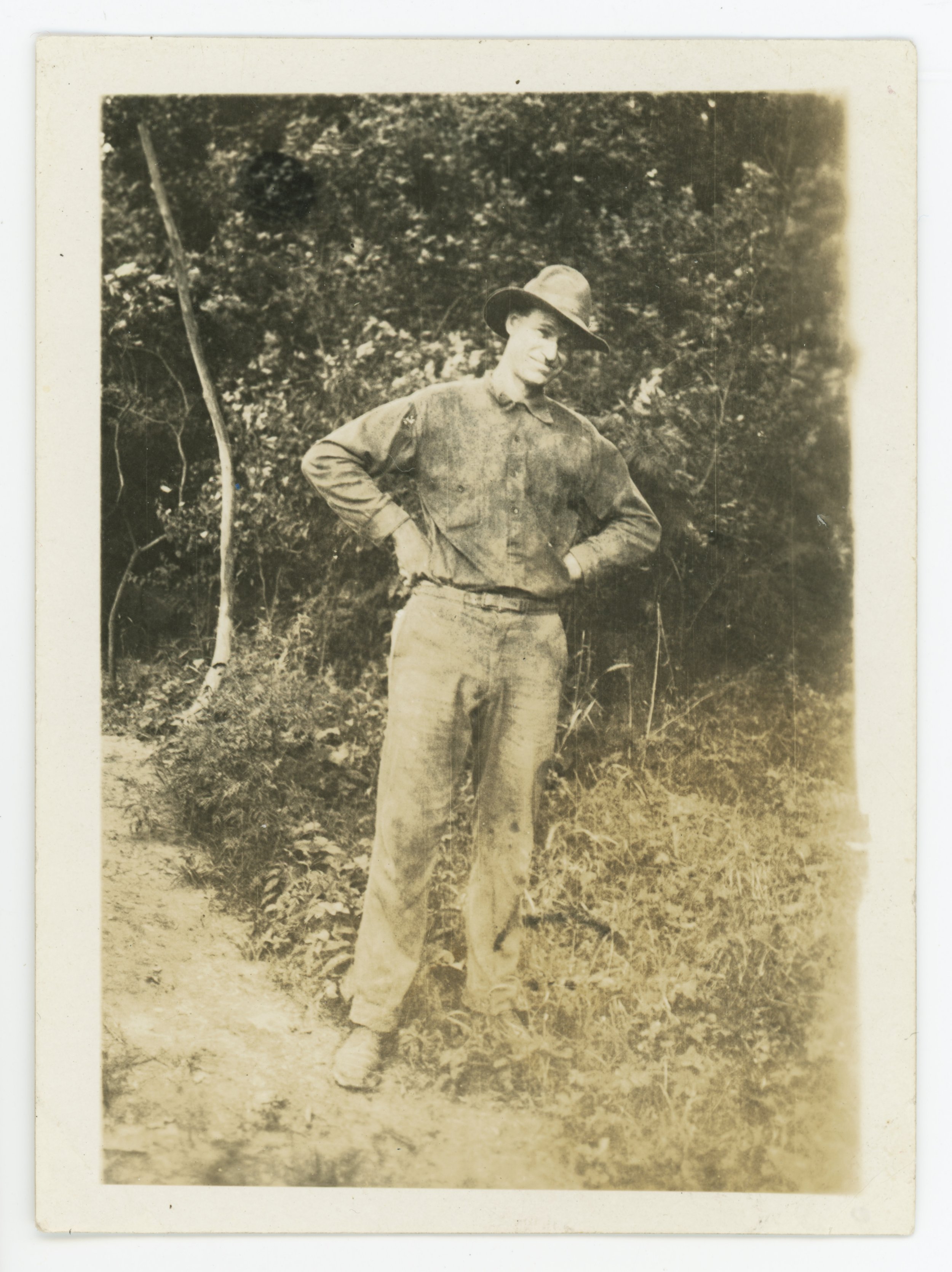
Young Jim Baldwin, circa 1923. Photo by Bill Koons. Courtesy of Fontenelle Forrest.
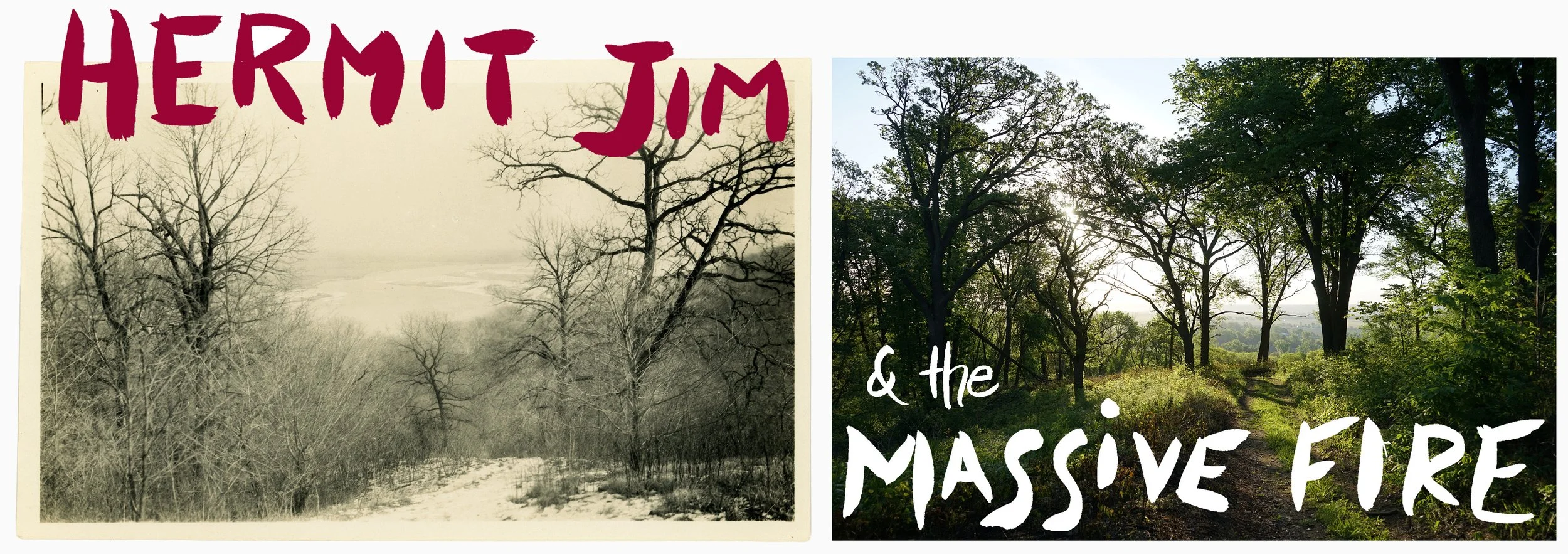
Image 01: A diptych of two landscape photos of the area around the homesite of Jim Baldwin. The black-and-white photo on the left is of a snowy forest scene, with bare trees and the Missouri River far in the background. The photo on the right shows a lush spring forest with light cutting through the trees and a trail leading over the crest of a hill. Text overlay reads: “Hermit Jim and the Massive Fire.” Image: Left image: taken by Bill Koons (ca. 1923). Courtesy of Fontenelle Forrest. Right image: © Patrick Mainelli (2026)
Image 02: Jim Baldwin stands in front of his hut, with one hand on his hip. The rough home is made of several small planks of wood and plastic sheets. Broken boards and trash litter the area. Baldwin wears torn pants and an old jacket. Image: Photographer unknown (ca. early 1960s). Courtesy of Fontenelle Forrest. Image resolution sharpened using Adobe Firefly AI tools.
Audio 01: Field recording made at the homesite of Jim Baldwin, May 9, 2026, dawn.
Image 03: Jim Baldwin sits among tall plants, gesturing with his hands while speaking to a group of four young women, also sitting on the ground, listening intently. Image: Photographer unknown (ca. mid-1950s). Courtesy of Fontenelle Forrest. Image resolution sharpened using Adobe Firefly AI tools.
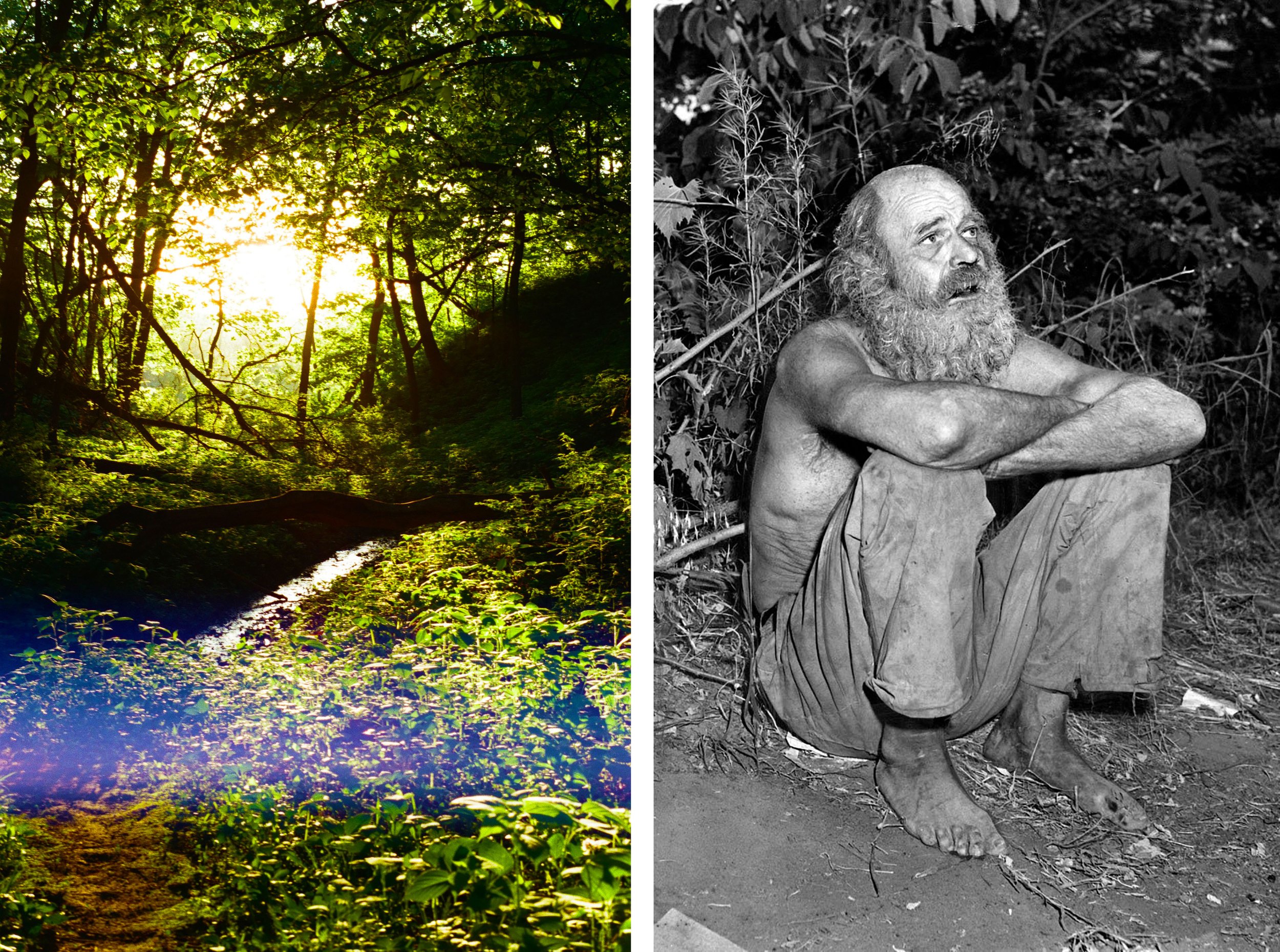
Image 04: A gauzy image of morning light cutting through trees in the area of Jim Baldwin’s homesite and reflecting off a small stream. Image: © Patrick Mainelli (2026)
Image 05: Jim Baldwin squats on the bare forest floor, looking up toward the sky. He is shirtless and barefoot with a long beard. Image: © Omaha World-Herald (ca.1950s)
Image 06: Four images paired together, each showing the author’s hand holding an artifact found at the Jim Baldwin homesite. From left to right: a partial ornate glass lid; a rusted pair of garden hand shears; a broken ceramic bowl; and the worn leather bottom of a shoe. Image: © Patrick Mainelli (2026)
Image 07: Film photo of muted yellow iris flowers planted by Jim Baldwin. A single flower is in focus in the foreground, while several others are obscured in a blurry background. Image: © Patrick Mainelli (2026)
Image 08: A young Jim Baldwin stands in the forest. With arms akimbo, Baldwin wears a hat and a slight smile. Image: Bill Koons (ca. 1923). Courtesy of Fontenelle Forrest.
Patrick Mainelli is a writer, photographer, and gardener living in Omaha. His nonfiction is concerned with themes of wilderness and change in American landscapes and culture. His work has twice been named among other “Notable Essays” in the Best American Essays series, and has been featured on the Public Radio program “Living on Earth.” He is most frequently thinking about flowers.